Design a Wedding Dress Online: From Idea to Something Makeable
An online design tool produces a picture of an idea. What a dressmaker needs is a set of decisions, and the picture cannot make several of them for you.
Online tools will produce a picture of the gown you describe, and the pictures have become good. What happens next depends on what you intend to do with one.
If the answer is “show it to someone who will make it,” the picture is the beginning of a conversation rather than the end of one.
Two different reasons to design one
Some people design a gown to see it — to work out what they want, to test an idea against their own taste, to have something to react to. That is a complete use, and nothing that follows applies to it.
Others design a gown intending to have it made, by a dressmaker, an atelier, or a made-to-order service. That is a different situation, because the picture now has to travel to somebody who needs to build the thing, and pictures carry less than they appear to.
A design image is a proposal
What a generated design gives you is an expression of intent. It shows a silhouette, a mood, a general idea of neckline and volume. It communicates what you are after faster than any description would, which is genuinely valuable.
What it is not is an instruction. A dressmaker cannot cut from it, because the information required to cut — where the panels divide, how much ease sits where, which edges join which — was never in the picture. That gap is well established for technical drawings, and a generated image sits further from a pattern than a technical drawing does, not closer.
The practical consequence: expect the picture to start the process rather than to shorten it. Somebody still has to make the decisions the picture implied without settling.
What a dressmaker actually needs
These are decisions rather than images, and having them ready changes a first meeting considerably.
• Silhouette, in a word you can both use — column, A-line, ball gown, fit-and-flare.
• Neckline and back, which are two decisions rather than one, and the back is the one most often left unspecified.
• Straps or sleeves, including whether they carry weight or are decorative, which is a construction question disguised as a style question.
• Fabric family and weight, or at least what you want the fabric to do — hold a shape, fall softly, catch light.
• Closure, since a corset back, a zip, and buttons produce different fittings and different alteration paths.
• Train length, in relation to the venue and how much of the day you will be moving.
• What you will be doing in it — outdoors, dancing, a long meal, stairs.
The last one is the item most often missing and the one that changes construction most. A gown for a garden ceremony and a gown for a seated dinner are different engineering problems, and a dressmaker can only account for that if told. It is also the item people leave out because it feels irrelevant to design — the day is the brief, and everything else is a response to it.
Reference images help alongside these decisions, and the useful ones show construction rather than mood — a reference transfers specific things, and a photograph of a back, a strap attachment, or a hem finish transfers more than an atmospheric shot of a whole gown does.
What generated designs leave out
The most common problem is not that generated gowns look wrong. It is that they give a maker no way to tell what is structural.
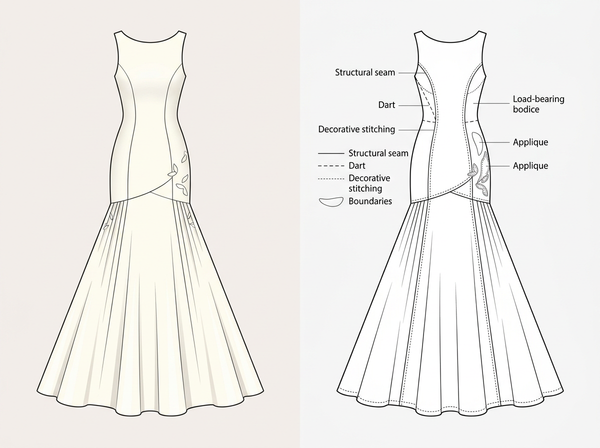
In a generated image, every line is rendered with the same visual weight. A seam that holds the bodice together looks like a decorative topstitch, which looks like a fold, which looks like the edge of an applique. The maker has to decide which is which, and their guess may not match what you were imagining when you liked the image.
Related problems follow from the same cause. Straps sometimes attach to nothing in particular. Bodices occasionally close in ways that could not be gotten into. Fabric occasionally does two incompatible things in one gown — stiff enough to hold a shape at the waist and fluid enough to pool at the hem, in what is clearly meant to be one material.
None of this makes the image useless. It means the image needs a conversation attached to it, and that the conversation should start with “which parts of this matter to you,” because a maker will otherwise preserve the parts that photograph well rather than the parts you cared about. A drawing that distinguishes structure from decoration is what a maker works from — that distinction is what makes a drawing usable rather than merely attractive.
Fabric is the decision the picture hides
The same design in two fabrics is two dresses.
A silhouette that requires structure will not hold in a soft fabric; a design that depends on fluid movement will not move in a stiff one. Volume, drape, how light behaves on the surface, and how heavy the finished gown is all follow from the material rather than from the shape drawn.
A generated image has to depict something, so it implies a fabric — it shows a surface with a particular sheen and a particular way of falling. What it cannot do is specify one, because weight and hand produce no visual signature that survives a picture. Two gowns that look identical in a rendering can differ substantially in what they are like to wear.
Which means fabric is a decision to make deliberately with your maker, ideally with samples in your hands, rather than a property to be inferred from the image you brought in.
What to bring to a first meeting
Bring the picture, and bring three things alongside it.
The decisions listed above, written down, including the ones you are unsure about — marked as unsure, which is more useful than leaving them blank.
Two or three construction references: photographs of specific features you want, from any source, ideally showing backs and details rather than full-length front views.
And a description of the day: venue, season, how long, what you will be doing. This shapes fabric weight and construction more than any aesthetic preference does.
What not to bring is a single image presented as a finished specification. It puts a maker in the position of interpreting rather than advising, and their advice is most of what you are paying for.
Where the money actually goes
Design tools are free or nearly so, which is presumably why the search for them includes the word. The expense in a custom gown sits somewhere else entirely.
It sits in pattern work — someone drafting a pattern to your measurements, which is skilled labor and the reason a custom gown differs from an altered one. It sits in fittings, usually several, each requiring your time and theirs. It sits in fabric, which for bridal can be a substantial share. And it sits in hand finishing, which is where hours accumulate invisibly.
None of those costs are affected by which tool produced your initial picture. Which reframes the free question usefully: the tool is not where your budget is at risk, and the picture’s quality is not what determines whether the gown works.
FAQ
Can a dressmaker work directly from a generated image?
Most will work from one as a starting reference and will ask questions before cutting anything. What they cannot do is treat it as a specification, since the information needed to cut a pattern is not present in a picture regardless of how detailed it looks.
Should I design before or after choosing a maker?
Designing first gives you something to communicate with; choosing first gives you someone to design with. Makers often have strong views about what suits a fabric or a body, and arriving with a fixed image can close off advice you would have wanted.
How specific should I be about fabric?
Specific about what you want it to do, open about which material achieves it. Naming an effect — holds its shape, falls softly, has a matte surface — gives a maker room to suggest options you would not have known to ask for.
What if my design turns out not to be makeable?
Most designs are makeable in some form; what changes is cost, fabric, or construction. A maker saying it cannot be done as drawn is usually saying it cannot be done in that fabric, at that price, or with that closure — which is a conversation rather than a refusal.
Is designing my own gown cheaper than buying one?
Custom work is priced on labor and materials rather than on whether the design came from you, so originating the design does not by itself reduce cost. What it changes is what you end up with.
How much can be changed after the first fitting?
Considerably more than with an off-the-rack gown, and less than people expect, since major structural changes mean re-cutting. Raising this early gives a maker the chance to build in flexibility where you might want it.
Where this leaves you
The picture is worth having. It communicates in seconds what a paragraph struggles with, and it gives you and your maker something concrete to disagree about, which is how these conversations make progress.
What it does not do is make the decisions. Fabric, structure, closure, and what the day asks of the gown are all settled by people rather than by images — and the design that arrives as a finished-looking picture can quietly conceal how many of those are still open.
Write down what the picture did not settle
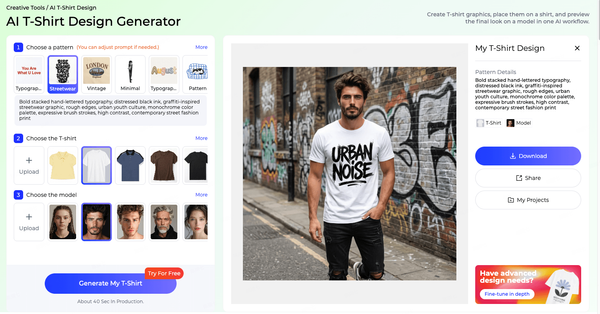
Take the design you generated and go through it against the decision list: silhouette, neckline, back, straps, fabric behavior, closure, train, and what you will be doing in the gown. Mark each as settled or open — being honest about the open ones is what makes a first meeting productive. The picture answered the first item and possibly the second. The rest are still waiting for you, and a maker can help with all of them once they know which ones are live. See how a described idea becomes a design.
Written by