
Amazon Product Image Requirements in 2026: The Rules That Changed
Most of the main image rules are the same as they were. What sellers experience as a change is an automated check reading values a human eye cannot judge.
Sellers who have listed on Amazon for a few years tend to describe the image requirements as having got stricter. The written rules are largely the same ones that have applied for a long time.
What changed is what reads them.
The rules as written
The main image requirements are stable and widely documented. The background must be pure white at RGB 255, 255, 255; the product should fill at least 85% of the frame; the longest side must be at least 1,000 pixels for zoom to function, with 2,000 pixels or more recommended; and text, logos, watermarks, and borders are not permitted on the main image.
Supporting images are governed far more loosely, which is where lifestyle context, infographics, and detail views belong. The asymmetry is deliberate on the platform’s part: search results have to look uniform, and everything after the click can look like whatever sells.
Category rules sit on top of the general ones and override them in places. Necklaces are the notable exception to the rule that a product must not be cropped by the frame edge, and mannequins are not permitted on main images outside certain apparel categories.
None of that is new. Which raises the question of why compliance feels harder than it used to.
It is worth being direct about this, because a great deal of writing on the subject implies that a fresh set of rules arrived and needs learning. As far as the published requirements go, that is not what happened. A seller who was compliant three years ago is compliant against the same text today. The difficulty sellers are reporting is real, and it originates somewhere other than the rulebook.
Looking white and measuring white
The rule says pure white. The check reads pixel values.
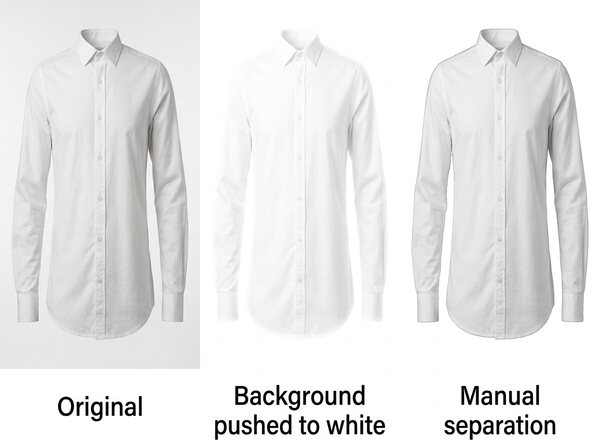
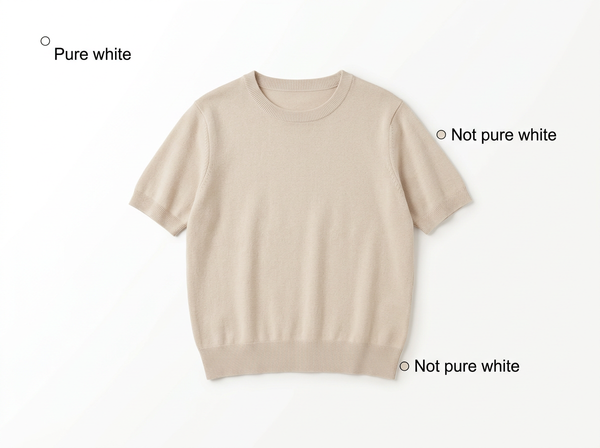
A physical white backdrop, photographed under real lights with a real camera, almost never produces exactly 255, 255, 255. Professionally shot backgrounds commonly land slightly below it — values like 252, 252, 252 are ordinary, and that difference is invisible to anyone looking at the image.
An automated system scanning the upload does not have that limitation. It detects backgrounds that are not exactly white even when the difference cannot be seen, which produces the experience sellers describe: an image that looks perfect, shot properly, in a studio, rejected.
The practical implication is that shooting on white and uploading is not a workflow that reliably passes. Something has to bring the background to the exact value afterward — which is a background replacement step rather than a lighting adjustment, and it deserves its own treatment.
Suppression is silent and can be retroactive
Two properties of enforcement matter more than any individual rule.
It is silent in the sense that a suppressed listing does not always announce why, and sometimes does not announce at all — the listing simply stops appearing in search. Sellers frequently discover suppression through a traffic drop rather than through a notification.
It is retroactive in the sense that passing once is not permanent. A listing compliant at upload can be caught later, when checks are tightened or extended to categories they did not previously cover. Images uploaded years ago are still subject to whatever the current check does.
Together these mean image compliance is a standing condition rather than a gate you pass. A catalog that has not been audited since it was built has an unknown compliance status, and the unknown resolves itself the first time traffic disappears from a page nobody was watching.
The asymmetry is worth noticing: the cost of a suppressed listing scales with how well that listing was doing. A page with no traffic loses nothing when it is suppressed. A page carrying a category loses everything, and it loses it quietly, which is the combination that makes this worth a scheduled check rather than an occasional one.
Where apparel gets complicated
The mannequin rule is the one that most affects clothing sellers, and it is layered rather than absolute.
The general position is that mannequins are not permitted on main images. Certain apparel categories are treated differently, which means a technique that is disallowed in one category may be acceptable in another — and the only reliable way to know is to check the requirements for the specific category being listed in, rather than reasoning from the general rule.
This is also why the ghost mannequin technique is common in apparel listings: it produces an image showing garment shape with no visible form. Whether that satisfies a given category’s requirements is again a category-level question, and worth confirming before a range is shot rather than after.
The broader point holds beyond apparel: how a garment is photographed has become partly a compliance decision rather than purely a creative one.
What a pre-upload check should contain
• Background value, verified with a color picker rather than by eye, at several points including near the product edge and in any shadow transition.
• Fill proportion, checked against the frame rather than estimated.
• Longest side in pixels, since the zoom threshold is a hard cutoff rather than a preference.
• Absence of text, logos, watermarks, and borders, including any added by an editing tool’s export settings.
• Category-specific rules for this listing, confirmed against current requirements rather than remembered.
Running that list takes a couple of minutes per image and prevents the failure mode that costs the most: discovering non-compliance after a listing has been live and accumulating history.
Why rejections cluster where they do
Rejections concentrate in a small number of places, and the concentration follows from the enforcement mechanism rather than from carelessness.
Background values, because the check is numeric and human judgment is not. Fill proportion, because it is estimated rather than measured. Text, because tools add it — export watermarks, resolution badges, template frames — without the seller intending it. And category overrides, because they are the part nobody re-reads.
What these have in common is that all four are invisible to the person reviewing the image. Nobody uploads an image they believe is non-compliant; they upload images whose non-compliance is not visible at the size and on the screen where the review happened.
That framing changes what a review should be. Looking at an image and judging it is not a check, because the properties being enforced are not properties looking can assess. A check is something a tool performs and reports, and the human role moves to deciding what happens when a value comes back wrong — which is a smaller job and a more reliable one.
Building a process that survives rule changes
Image requirements will keep changing, and the changes will not always be announced in a way that reaches you.
The practical response is not to memorize the current rules. It is to hold the rules in one place that gets checked on a schedule, so that a change is discovered by a review rather than by a suppression. A short document, reviewed at a fixed interval, with a date on it. The date is the part that matters most, since a rules document with no date on it is indistinguishable from a current one and will be treated as current indefinitely.
The same document should record which categories your listings sit in, since category rules are where the exceptions live and where general knowledge stops applying. And it belongs alongside whatever governs how your product pages are assembled, because compliance and page construction are decided by the same people at the same time.
FAQ
Does a listing get removed or just hidden?
The common outcome is suppression from search results rather than removal, which is harder to notice because the listing still exists and can still be reached directly. Checking whether your own listings appear in search for their exact titles is a quick way to detect it.
Can I use a rendered image instead of a photograph?
The general requirement is that the main image show the actual product, with limited category exceptions. Whether a rendered image qualifies is a category-level question and one worth confirming directly rather than inferring.
Do the rules differ between Amazon marketplaces?
Requirements are broadly aligned across marketplaces and category rules vary, so a range selling in several regions should confirm requirements per marketplace rather than assuming one check covers all.
How often should a catalog be audited?
Often enough that a rule change is caught before it produces a suppression, which for most sellers means at least once a year plus whenever a new category is entered. An audit that only happens after a problem is a response rather than a process.
Is 85% fill measured strictly?
It is stated as a threshold and enforced by an automated check, which suggests treating it as a measurement rather than an impression. Estimating by eye is the same category of error as judging white by eye.
What should I do if an image is rejected without explanation?
Work through the pre-upload checklist against the specific image before resubmitting, since resubmitting an unchanged image produces the same result. The four common causes above account for most rejections.
Where this leaves you
The requirements are not hard to satisfy. They are hard to satisfy reliably, because the properties being checked are properties a person cannot assess by looking.
That is the actual change of the last few years, and it has a specific consequence: the review step that used to happen in someone’s judgment now has to happen with a tool. An image that a competent person looked at and approved is no longer evidence of anything, which is uncomfortable and is simply how the check works.
Pick a color and check it
Open one of your current main images, take a color picker to three points — a corner, somewhere near the product edge, and any shadow transition — and see whether all three read as pure white. Most sellers find at least one that does not, on an image that has been live and passing for some time. That result tells you whether your workflow produces compliant images or images that have not been checked yet. See how product page structure and image sets are put together.
→ https://www.style3d.ai/ai-photoshoot/ai-fashion-pdp-layout
Written by