
At-Home Wedding Dress Try-On: What a Photo Can Settle
An image settles silhouette, neckline, and proportion well enough to build a shortlist. It carries no information at all about what wearing the gown is like.
Trying gowns on at home — from photographs, from an app, from a mirror and a phone — has become a normal first step. It works well for the thing it is good at, and the thing it is good at is narrower than most people assume.
An image can tell you what a dress looks like. It cannot tell you what wearing one is like, and for this particular garment the gap between those two is unusually wide.
What the image is actually for
The useful frame is shortlisting rather than deciding.
Appointments are limited. Travel takes time, samples are held in one or two sizes, and most people will try on far fewer gowns in person than they will look at. What an image does is decide which ones are worth an appointment — and doing that well is genuinely valuable, because a shortlist built from good information means the in-person time gets spent on real candidates.
Deciding is a different act, and it requires information the image does not carry. An image can settle appearance without settling how something fits or feels, which is true of clothing generally and unusually consequential here.
What a photo settles well
Silhouette family. Whether a full skirt or a column suits your proportions is visible immediately, and it is the single biggest narrowing decision available. A shortlist that has settled this is already most of the way there.
Neckline against your face and shoulders. Where a neckline sits, how it frames, whether a strap line works — all visible, all reliable.
Overall scale. How much dress there is relative to you, which sounds obvious and is frequently the thing that eliminates a gown someone loved on a hanger.
Color, with a caveat. Bridal whites vary more than people expect, and the difference between them against your skin is visible in a photograph — provided the photograph is taken in daylight rather than under indoor lighting, which shifts every white toward itself.
Weight is the thing it cannot carry
A wedding dress is worn for a long day. It is carried on the shoulders, or the waist, or the hips, for hours, through a ceremony and a meal and an evening.
Nothing in a photograph relates to this. There is no sag to read, no sign of what is bearing the load, no version of the image taken three hours in. A gown that photographs identically to another can weigh substantially more, because weight comes from construction — layers, boning, an internal structure, a train — and construction is largely invisible under a finished surface.
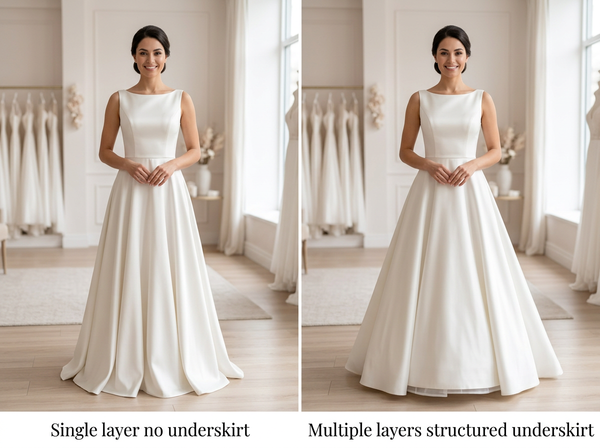
This is the general principle that fabric is a structure rather than a surface, arriving in the place where it matters most. Two gowns with the same outline can be built completely differently underneath, and the photograph shows the outline.
What makes this worth planning around is that weight is often the first thing brides notice on the day, and the thing they had least warning about. It is also not something to be avoided — many gowns are worth their weight — but it is something to have felt before committing.
There is a related detail worth knowing: where the weight sits matters as much as how much there is. A gown that carries its load on the shoulders feels entirely different from one of similar weight supported at the waist, and both feel different again from one held up by a fitted bodice. Standing in a fitting room for two minutes will not reveal this. Standing in it while you have a conversation, and noticing what you are aware of at the end of it, will.
Movement is the second thing
A photograph records one arrangement, at rest, standing still.
The day involves walking, sitting down and standing up again, stairs, possibly grass or gravel, and dancing. A hem that hangs beautifully in a static frame can drag, catch, or swing in a way that changes the whole look — because changing the pose changes the drape rather than merely changing the view.
Sitting deserves specific mention. A structured bodice that is comfortable standing can be a different experience through a seated meal, and no image addresses this at all. Neither does a brief try-on in a shop, unless you sit down in it.
Stairs and thresholds are the other common surprise. How much of the skirt needs gathering to move through a doorway is a practical question with a physical answer, and it is worth having that answer before the day rather than during it.
What changes between the sample and your dress
The gown in any image is a sample or a rendering, and the one you wear is neither.
Samples exist in limited sizes and are tried on with clips at the back to approximate a fit. What you see in a mirror at an appointment is a gown pinned to you, not a gown made for you — and the same is true of any image showing a sample.
Almost every bridal gown is altered, and alterations change how a dress looks as well as how it fits. The dress you receive will differ from the sample in ways that are usually improvements and are always changes.
Bridal sizing also runs on its own conventions rather than the ones used for everyday clothes, so the size on a bridal tag is not a comparison to anything in your wardrobe. That is a subject in itself, and the practical point here is only that a size number in a listing tells you very little.
How to use the images properly
• Shoot in daylight, near a window, without a filter. Indoor light shifts whites, and a filter shifts everything.
• Take a photograph sitting down, if you are trying on anything physical. It is the single most informative extra frame and almost nobody takes it.
• Photograph from the side and back, not only the front, since trains and backs are where gowns differ most and where front views are least informative.
• Keep the shortlist small enough to actually visit. An image-based shortlist that nobody can travel to has moved the problem rather than solved it.
The discipline that makes all of this work is deciding, before you look, what each image is supposed to answer. Images looked at without a question tend to produce a general feeling rather than a decision.
When at-home try-on is enough on its own
There are real cases where it is.
A gown you have already worn something similar to — same silhouette, same construction, same designer — carries much less uncertainty, because the unknowns the image cannot cover are ones you have experienced.
A simple, unstructured gown in a light fabric has far less hidden construction, so the gap between how it looks and how it wears is genuinely small.
And a purchase with a straightforward return path changes the calculation entirely, since the try-on can happen at home with the actual garment rather than with an image of it.
Outside those situations, the image is doing the first half of the job well and leaving the second half open.
The reverse case is worth naming too. A heavily structured gown, in a silhouette you have never worn, from a designer whose construction you do not know, is where the gap between image and experience is widest. Those are the gowns most worth an appointment and, awkwardly, often the ones most compelling in photographs — because structure photographs beautifully and is felt entirely differently.
FAQ
Can I judge the color accurately from a photograph?
Reasonably, in daylight, without filters, on a screen you have not adjusted. Bridal whites differ from each other more than most people expect, and those differences do survive a well-taken photograph — indoor lighting is what destroys the comparison.
How many gowns should be on a shortlist?
Few enough that each can be tried on properly, with time to sit down and move around in it. A long shortlist tends to produce rushed appointments, which forfeits exactly the information the appointment existed to gather.
Does a virtual try-on show me how it will fit?
It shows proportion and silhouette on your shape, which is useful. Fit in the sense that matters for a gown — where it sits, whether it stays there, how it feels after hours — is not something an image resolves.
What about the veil?
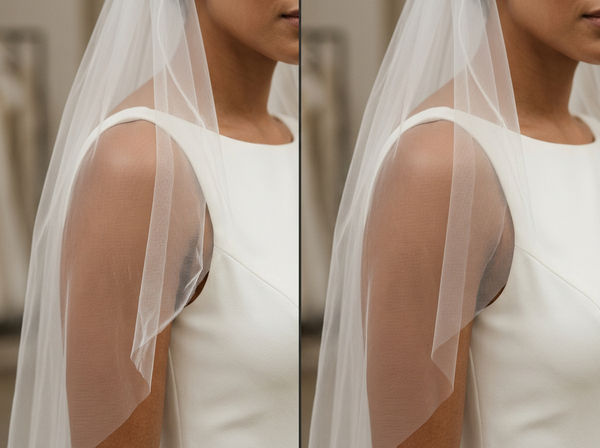
Veils behave differently from the gown, because they are sheer and because they layer over everything else. That is a distinct question worth treating on its own terms.
Should I try on the sample size even if it is not mine?
It is standard practice and it is informative, provided you understand what you are looking at — a gown clipped to approximate a fit, which tells you about the design rather than about the finished garment.
Is it worth photographing myself at the appointment?
Yes, from several angles including seated, and in the same conditions each time so the gowns can be compared. Memory of gowns compresses quickly once several have been tried.
Where this leaves you
Use the images to decide where to go, then use the appointment to answer what the images could not.
The questions worth saving for the fitting room are physical ones: how heavy is it, what happens when I sit, how much of it do I have to carry through a doorway. None of those have visual answers, which is why they survive every round of looking and then arrive all at once on a day when nothing can be changed. A shortlist built on what images do well, followed by an appointment spent on what they cannot, is the arrangement that uses both properly.
Save the physical questions for the fitting room
Before your next appointment, write down three things you cannot learn from a photograph: how much the gown weighs on your shoulders, what it does when you sit, and how much of the skirt you have to gather to get through a door. Then make sure you actually test all three while you are wearing it. Images are good at narrowing a list and silent on everything that happens after the standing-still photograph. See how virtual try-on works and where it stops.
→ https://www.style3d.ai/ai-photoshoot/virtual-clothing-try-on
Written by