How to Make a Mannequin: Build a Digital One Instead
A homemade form copies one body on one day. That is exactly right for fitting your own clothes and exactly wrong for photographing a range. Which you need.
Two different needs sit behind this question, and they have opposite answers.
One is wanting a form shaped like you, so that clothes can be fitted to your own body without a second person. The other is wanting a form to photograph products on. The first is well served by making one yourself. The second is not, and the reason is worth understanding before spending a weekend on it.
What a homemade form actually gives you
The common method is a wrap. Wear an old fitted shirt, have someone cover it in tape in overlapping layers until it holds shape, cut it off up the back, seal the cut, and fill it. Variations use paper tape, plaster bandage, or a knitted cover over a stuffed base, and the principle is the same throughout: take an impression of a body and make it rigid.
What that produces is genuinely useful, and it does one thing no commercial form does. It captures one specific body, including everything asymmetrical about it — a shoulder that sits lower, a rib cage that is not centered, a posture that is yours. Commercial forms are idealized and symmetrical. A wrapped form is not, and for fitting your own clothes that is the entire point.
It is also cheap, and it can be made in an afternoon by someone with no equipment. The one thing it does require is a second person, since wrapping your own back is not workable — which is worth knowing before setting aside the afternoon.
Where it falls short as an object
Set aside what it represents for a moment and consider what it is as a piece of equipment.
Rigidity is the first issue. A taped shell over stuffing compresses when pressure is applied, so measurements taken from it shift depending on how hard the tape is pulled. Pinning into it works unevenly — some spots hold, others tear.
Stability is the second. A stand fitted to a homemade shell is usually improvised, and a form that shifts slightly between shots introduces variation that nothing downstream can remove.
Surface is the third. Tape and filler produce a texture and a sheen that show through lightweight fabrics under studio light, which matters not at all when fitting and quite a lot when photographing.
None of these are fatal for the fitting use. All of them are irritating for the photography use.
The three ceilings
Beyond the equipment issues, three limits apply to anything made this way, and they are structural rather than a matter of execution.
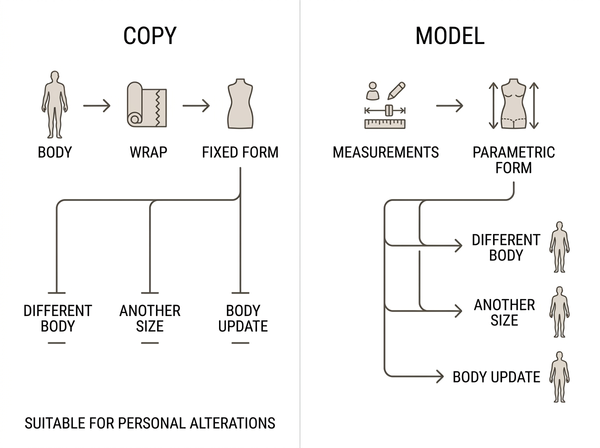
It is one body. The form is a copy of a particular person, so every garment on it reads correctly for that person and approximately for nobody else.
It cannot become another size. There is no mechanism to turn it into the next size up. A range needs its shape at more than one point, and a copy provides exactly one.
It cannot be updated. Bodies change. A form made from a wrap can only be remade, not adjusted, because there is no underlying description of it — the form is the record.
Those three are the same fact stated three ways: what you made is a copy, not a model. A copy is complete and finished and cannot be interrogated. A model has parameters, and parameters can be changed.
Which ceilings matter depends on what you are doing
For fitting your own clothes, none of the three is a real constraint. One body is what you wanted. Grading is irrelevant, since you are not producing a range. Updating happens by making another one in a few years, which is an afternoon.
If that is your situation, make the form. It is the correct answer and the rest of this article is about a different problem.
For photographing products, all three bite immediately. One body means every garment is shown on a shape that corresponds to one person rather than to your sample size. No grading means a range spanning sizes has no way to show anything but the one. No updating means the form degrades and cannot be corrected.
There is a further problem specific to the photography case: a form built from a person is not built to the sample size, and the mismatch propagates into every image. An image can settle appearance without settling fit, and a form that corresponds to nobody’s sample size settles neither.
What a digital form does differently
The difference is not that it is digital. It is that it is described rather than copied.
A digital form is built from measurements, which means the measurements exist separately from the form and can be changed. Adjust one and the form changes. Enter a different set and you have a different form. Neither operation requires remaking anything.
That produces three capabilities the wrapped form structurally cannot have. One form per size, so a range can be shown across its span. A form that corresponds to the sample size rather than to whoever was available to be wrapped. And a form that updates when the reference body or the size chart changes, without starting over.
It is also reproducible, which matters more than it sounds. The same form, the same position, the same framing, applied to every style — additional views generated from a fixed setup rather than reconstructed each time. A physical form has to be repositioned identically by hand, and a homemade one has to be repositioned identically by hand on a stand that was not designed for it.
What the digital route cannot do
Being straight about this matters, because the two approaches are not substitutes across the board.
You cannot pin to a digital form. Every shaping decision that happens physically at capture — drawing in excess, supporting a neckline, filling a sleeve — has no equivalent, and where a garment genuinely needs that treatment, a physical form is doing something no digital one replaces.
You cannot drape real fabric on it. A digital form tells you nothing about how the actual cloth behaves, because there is no actual cloth involved.
And you cannot use it to check a sample. Assessing whether a produced garment hangs correctly requires the garment and something to hang it on, and a digital form participates in neither half of that.
Which means most operations end up with both: a physical form for assessing real garments, and a digital setup for producing consistent imagery across a range.
Choosing between them
The question that separates them cleanly is whether you need one shape or many.
One shape, corresponding to one specific body, used to fit garments made for that body: make it. The wrap method is the right tool and no digital approach improves on it for that purpose.
Many shapes, corresponding to sizes, used to photograph a range consistently over time: a copy of one person cannot get you there regardless of how well it is made. What is needed is something described rather than impressed, because a range is judged as a set and a set needs a shape that can be held constant and varied deliberately.
The common mistake is starting with the first because it is cheap and discovering the second requirement a season later, with a form that cannot be extended toward it.
FAQ
Can a homemade form be used for product photography at all?
It can, for a small number of styles where the size mismatch is tolerable and the surface does not show through. What it cannot do is support a range across sizes or hold consistent over time, so it works as a starting point rather than as a foundation.
Is a commercial adjustable form a middle option?
It solves the size problem partially, since the adjustment points are limited and the resulting shape corresponds to no particular person. It solves the rigidity and stability problems well, which for photography are the more immediate obstacles.
How accurate does a wrapped form need to be?
For fitting your own clothes, accurate to your body — which the method achieves naturally, since it takes an impression. Precision in the usual sense matters less than the impression being taken over the right base layer and not pulled tight.
What about scanning a body instead of wrapping it?
A scan produces measurements and a surface, which is closer to a described form than to a copy. What it captures is one moment of one posture, so it inherits the one-body limit while removing the physical construction problems.
Does a digital form need to match a real person?
For anything where fit is being assessed, it should correspond to the body your fittings actually run on. For pure imaging consistency, correspondence to the sample size matters more than correspondence to a specific person.
Can I make a form of myself and use it to sell clothes online?
The garments will be shown on your shape rather than on the size they are sold as, which is a mismatch customers experience as inconsistent sizing. It works while you are selling one size to people shaped like you and stops working as soon as either of those changes.
Where this leaves you
Ask whether you need a shape or a description.
A wrap gives you a shape — a good one, specific to a real body, made cheaply in an afternoon. For fitting your own clothes that is exactly right, and nothing here argues otherwise. For photographing a range it is a starting point that does not extend, because a copy has no parameters and everything a range needs is a change to a parameter: another size, another body, the same body a year later.
Decide which problem you are solving
Before you start taping, answer one question: is this form for fitting clothes to one body, or for photographing garments across a range. If it is the first, the wrap method is the right tool and works well. If it is the second, a copy of one person cannot grow into what a range needs — no size run, no correspondence to your sample size, no way to update it. Knowing which one you are building saves the afternoon spent building the wrong one. See how a consistent product image set gets built.
Written by