
Changing Garment Color in a Photo: The Apparel-Specific Rules
A garment is several fabrics joined by seams, with parts that must not change at all. Which rules follow from that, and why direction of change matters most.
Recoloring a material is difficult for reasons that apply to any textured surface. Recoloring a garment is difficult for additional reasons that apply only to garments, because a garment is not a piece of fabric — it is several pieces of fabric, joined, with things attached to them that were never meant to change color at all.
Direction decides what is possible
The single most useful rule is about which way the change runs.
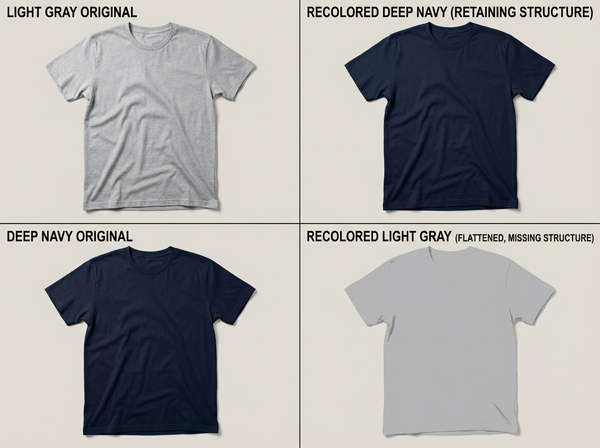
Light to dark works. A pale garment photographed properly records its own structure in the shadows: where it folds, where a seam pulls, how the fabric falls across a shoulder. Darkening it carries all of that information along, because the information is present and is simply being shifted.
Dark to light does not. A dark garment has shadows that have already gone to black, and black holds no detail. Lifting them produces noise and invention rather than folds, because there was nothing recorded in those areas to lift.
That asymmetry has an immediate practical consequence for anyone planning a range of colorways from one sample: photograph the lightest colorway, not the most attractive one. The lightest version contains the most information and can become any of the others. The darkest version can become nothing.
This is the decision most often made backwards, because the sample chosen for photography is usually the hero color, and the hero color is rarely the palest.
A garment is several fabrics
A t-shirt looks like one material and is usually two. The body is one knit; the neckband, and often the cuffs and hem, are a different structure — heavier, tighter, constructed to hold its shape.
Those two take dye differently in production and they photograph differently. The rib appears slightly deeper in tone, catches light along its ridges, and shows the color at a different apparent saturation than the flat body does.
A recolor applied to the whole garment as one surface removes that difference. The result reads as a garment cut from a single cloth, which is not what will arrive. This is the general principle that cloth is a structure rather than a surface, showing up as a construction fact rather than a material one: the two fabrics are different objects that happen to be sewn together.
The same applies to a shirt with a woven body and a different interlined collar, to a jacket with contrast panels, and to anything with a lining visible at an opening.
Some parts must not change at all
A garment carries things whose color is a separate decision, and a selection made by color rather than by object will include them.
Printed graphics do not change with the base color — a print applied to a garment is its own artwork with its own colors, and the same print appears across every colorway unaltered. Hardware does not change: zips, buttons, eyelets, and cord stops belong to a trim decision made separately.
Labels and woven tags do not change. Contrast topstitching does not change, while matching topstitching should — and no tool can tell which is which, because both look like thread of a particular color.
That last one is the most common error in production recoloring, and the only reliable prevention is knowing the garment rather than inspecting the image.
Seams flatten first
A seam is a doubled layer of fabric with thread through it. In a photograph it reads as a subtle line of deeper tone, and that line is doing a lot of work — it tells the viewer where panels meet and gives the garment its construction.
Recoloring tends to reduce seam contrast, because the tonal difference between seam and panel is small and gets compressed when a color is replaced. What survives is a garment that looks slightly softer and less made, in a way that is difficult to point at.
The effect is worst on garments whose appeal is construction — tailoring, structured outerwear, anything where the panel layout is the design. It matters least on simple, soft garments where the seams were never a visual feature.
Which produces an unhelpful pattern: recoloring works best on the garments that need it least. A plain jersey tee recolors cleanly and is also cheap enough to photograph in every colorway. A tailored jacket is expensive to photograph repeatedly and is exactly the garment where recoloring loses the most.
Checking seams specifically, at magnification, is the fastest way to tell whether a recolor has preserved construction or merely preserved texture.
White and black are the hardest starting points
Both extremes fail, for opposite reasons.
A white garment has no color to change. Its entire appearance is shading — the folds, the shadows, and the slight tonal variation across the surface are all the image contains. Recoloring it means assigning a color to a surface defined only by its lightness, and the result frequently looks like a flat tint applied over a photograph, because in a sense that is what it is.
A black garment has the opposite problem, already described: no highlight information to work with, so any lightening invents.
Mid-tone garments are the reliable starting point, and a mid-tone in a neutral hue is the most flexible sample a range can be photographed in. That is rarely the color anyone wants to shoot, which is why it needs to be a planning decision rather than a preference.
There is a partial exception worth knowing. A white garment shot with deliberate separation lighting — enough directional light that the folds carry real tonal range — recolors far better than one lit flat, because the shading it does have becomes usable information. White is difficult rather than impossible, and the difference is decided in the studio.
What recoloring cannot settle
A recolored image shows what a colorway would look like. Whether the garment can be made that color is a separate question with a separate answer.
Fiber content constrains what dyes will take. Some colors are achievable in one fabric and not in another, which matters for any garment combining materials — a shell and a lining given the same value in an image may be undyeable to the same shade in reality.
And two fabrics matched in an image will not necessarily match in a shop, because how a color reads depends on the surface showing it. That is a property of the materials, and it is decided at the dye house rather than in a file.
How to shoot if recoloring is planned
• Photograph the palest colorway, since it holds the most information and can become the others.
• Choose a neutral rather than a saturated sample, because a strongly colored base leaves a cast that has to be removed before anything else can be applied.
• Light for shadow detail, not for a clean look — the shadows are the structure, and a flatly lit garment recolors into a flatter one.
• Shoot prints and hardware sharply enough to mask, since they will need to be excluded and a soft edge makes that harder.
• Keep the original, uncompressed, because every subsequent colorway is derived from it and compression artifacts propagate into all of them.
That list costs nothing at the shoot and determines how many colorways can be produced afterward. Deciding it after the shoot means deciding it with whatever was captured.
It is worth attaching to the sample request rather than to the shoot brief, since the sample has to arrive in the right colorway for any of it to apply. By the time a shoot is being planned, the sample that exists is the sample that will be photographed, and how many colorways a range can show has already been decided by whoever picked which one to make first.
FAQ
Can I recolor a black garment at all?
Into another dark color, generally yes, since you are moving within a range where the available detail is similar. Into anything substantially lighter, the result is unreliable and usually needs a fresh photograph.
Why does my recolored shirt look like a flat shape?
Most often because the base garment was white or very pale in a way that carried no color information, or because the shadows were compressed during processing. Either way the shading that gave the garment form has stopped varying.
Should the neckband be recolored separately?
On any garment where the rib is visually distinct, yes — treating it as its own region preserves the difference that will exist in the finished piece. On garments where the two are barely distinguishable it makes little difference.
How do I handle a print that spans a seam?
Mask the print as one object rather than following the garment’s regions, since the print does not change and the seam beneath it does. This is fiddly and is the correct approach.
Is recoloring accurate enough for customers to choose a color from?
It shows the relationship between colors reliably and the absolute color less so. Where a customer is choosing between colorways, that is usually sufficient; where they are matching to something they own, it is not.
Does this apply to knitwear?
More strongly, since a knit’s structure is deeper than a woven’s and more of its appearance comes from shadow inside the stitch. Knitwear rewards shooting for shadow detail more than any other category.
Where this leaves you
Before recoloring anything, look at what the photograph actually contains.
If the garment is pale and lit for shadow detail, most colorways are reachable from it. If it is dark, or white, or lit flat, the range of achievable results is narrow regardless of the tool — and the constraint was set at the shoot, by someone choosing a sample and a lighting setup without knowing that decision would determine how many colorways a season could show.
Photograph the palest one
If a range is going to produce colorways by recoloring, the sample that gets shot should be the palest available, in the most neutral hue, lit so the shadows keep their detail. That version can become any of the others. The hero color — deeper, more saturated, more attractive on the day — can become almost nothing, and by the time anyone discovers that, the sample has gone back and the shoot is over. See how colorways are produced from a garment.
→ https://www.style3d.ai/ai-fashion-design/clothing-colorways
Written by