
Clothes Try On Online: What It Fixes and What It Doesn’t
Before building clothes try on, split your returns into appearance and fit. Only one of those categories responds to a visual tool.
The pitch is that letting shoppers see themselves in a garment reduces returns. The reasoning behind that pitch is where it falls apart, because most apparel returns are about fit, and a try-on shows appearance.
Those are different things. A shopper looking at a convincing image of themselves in a dress learns what the color does against their skin, roughly how the silhouette reads on their frame, and whether they like it. They do not learn whether it will be tight across the shoulders. Deciding what to build, buy or promise starts with holding those two apart.
Appearance and fit are separate questions
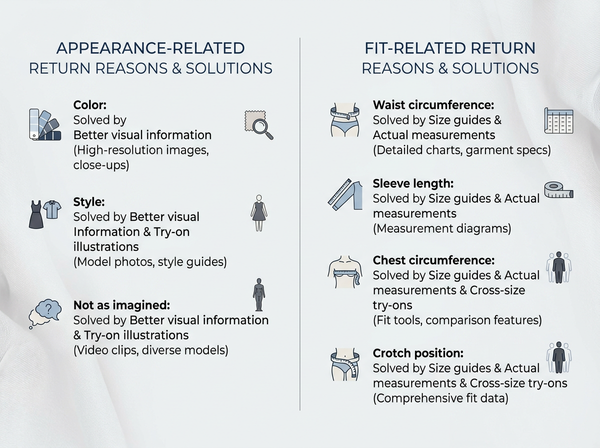
Appearance questions are the ones a good try-on answers well. Does this color suit me, does this length work on my proportions, does this shape read the way I hoped, do these two pieces work together. These drive a real share of hesitation before purchase and a real share of the returns coded as “not as expected” or “changed my mind.”
Fit questions are different. Will the waist sit right, is the sleeve long enough, does it pull across the chest, is the rise too low. Answering these requires measurements — of the garment and of the person — and no image-based process has either.
The distinction matters commercially because the two categories of return respond to different fixes. Appearance-driven returns respond to better visual information, which a try-on provides. Fit-driven returns respond to better size guidance, garment measurements, fit models across the size range and clearer sizing language. A try-on deployed against a fit problem will not move the number, and the disappointment that follows usually gets blamed on the technology rather than on the diagnosis.
There is a second-order effect worth naming. A try-on that resolves appearance uncertainty can raise conversion on items a shopper would otherwise have skipped, and some of those extra orders come back for fit reasons. The visualization did its job and the fit gap did its job, and the net return rate can move very little while both underlying numbers changed. Measuring the two categories separately is the only way to see what actually happened.
Look at your own return reason data before deciding what to build. If the reason codes are dominated by fit, that is a sizing project. If they cluster around color, style and expectation, visual tools are the right lever.
Shopper photos are a harder input than studio images
Merchant-side imagery starts from controlled inputs: even lighting, a clean backdrop, a pose chosen for the garment. A shopper’s photo is whatever their phone captured in their hallway.
That changes the difficulty in specific ways. Mixed household lighting produces color casts that make garment color unreliable. Casual poses put arms across the body, which hides the exact regions that need reconstructing. Backgrounds are cluttered, so subject separation is harder. Camera angle varies wildly, and a low-angle phone shot distorts proportion in ways that then distort the garment.
Results consequently vary far more than a studio pipeline would suggest. A demonstration built on clean stock photos is not evidence about what your customers’ photos will produce, and evaluating on realistic user photos before committing is the difference between a feature that works and one that generates support tickets.
What it does well enough to be worth having
• Color against skin tone, which is a frequent source of hesitation and something a flat product shot genuinely cannot answer for an individual.
• Silhouette on a body other than a fit model’s, which helps most in categories where the same style reads very differently across body types.
• Outfit combinations, where the question is whether two pieces work together rather than whether either one fits.
• Reducing the number of items ordered purely to compare, which is a real cost driver in categories where shoppers habitually buy three and keep one.
That last one is often underrated. Even where a try-on cannot answer a fit question, it can stop someone from ordering three colors to see which suits them, and the operational saving there is separate from any change in return rate.
The merchant-side version of this — generating the on-model imagery from your own garment photographs — is a different job with the same underlying technology, and for most catalogs it is the one that pays off first, since it improves every listing rather than only the sessions where a shopper uploads a photo.
The privacy obligations are not the same as your own imagery
Asking customers to upload photos of themselves changes your legal position, and this is the part that most often gets addressed after launch rather than before.
A shopper’s photo is personal data, and in many jurisdictions a photo of an identifiable face carries additional protections beyond ordinary personal data. Several jurisdictions treat biometric information as a separate category with its own consent requirements, retention limits and penalties, and some of them attach those rules to processing that a team would not intuitively describe as biometric.
Four questions need answers before a feature ships, not after. What are you retaining and for how long. Who processes it, including any third party in the chain. What are you telling the customer, in language they will actually see rather than in a linked policy. And what happens on deletion request, including copies held by a vendor.
None of these are reasons not to build it. They are reasons to involve whoever handles your privacy compliance at the design stage, since retention and vendor arrangements are expensive to change after launch and cheap to specify beforehand.
Where a shopper try-on earns its place
Category | Value of try-on | Why |
Occasion and statement pieces | High | Appearance is most of the decision, fit is often forgiving |
Outerwear and knitwear | Medium to high | Silhouette and color matter, fit is comparatively tolerant |
Basics and tees | Low | Little uncertainty to resolve, high familiarity |
Denim | Low | Return driver is overwhelmingly fit, not appearance |
Tailoring | Low | Fit is the product, and appearance without fit is misleading |
Swimwear and lingerie | Avoid | Fit and coverage are the product, and an inferred drape near an implied fit claim is a poor place to be |
The pattern is that value rises where appearance uncertainty is high and fit tolerance is generous, and falls to nothing where fit is the product. A category-by-category decision beats a site-wide rollout, and it protects you from the case where the feature is most convincing exactly where it is least appropriate.
What to tell customers, and what not to
The temptation is to describe a try-on as showing how something will look on you. The accurate version is that it shows how the color and shape read on a body like yours, which is a smaller claim and a defensible one.
The gap matters because an overstated claim converts a satisfied customer into a disappointed one at the moment of delivery, and disappointment at delivery is more expensive than hesitation at checkout. It also creates exposure where advertising standards require that product representations be accurate.
Pairing the visual with real fit information is what makes the combination work: garment measurements, the model’s measurements and size worn, and clear guidance on how the piece is intended to sit. The image answers what a shopper cannot get from a size chart, and the size chart answers what the image cannot.
What a try-on cannot do
It cannot tell anyone whether a garment fits. There is no measurement of the person and no measurement of the garment in the process, so the drape shown is a plausible rendering rather than a prediction.
It cannot represent fabric behavior faithfully. Weight, stretch, hand and how a fabric moves are not derivable from a flat photograph, so a heavy knit and a thin one can render similarly while behaving nothing alike in the room.
It cannot be relied on for color accuracy on a shopper’s device. Between household lighting, phone processing and an uncalibrated screen, the color shown is indicative and should not be the basis of a color-matching purchase.
It cannot substitute for a good size chart and honest copy. Where those are missing, adding a visual tool changes what the customer sees before purchase and nothing about what arrives, and the failure modes underneath any image-based garment change are worth understanding before promising outcomes, as covered in how a clothes swap is actually computed.
Frequently Asked Questions
Will a try-on reduce our return rate? Only against appearance-driven returns, and only if those are a meaningful share of yours. Pull your return reason codes first: if fit dominates, the lever is sizing information rather than visualization, and a try-on will not move the number regardless of how good it looks.
Do we need shopper photos at all? Not necessarily. Much of the benefit comes from richer on-model imagery across the size range, which requires no customer upload and carries none of the privacy obligations. Consider that before building an upload flow.
How accurate does the result need to be? Accurate enough that a customer’s expectation is not violated at delivery. That standard is lower than photorealism and higher than “recognizably them,” and the failure that matters is not an artifact but an impression the product cannot live up to.
What should we do about privacy? Decide retention, processing and deletion before launch rather than after, and involve whoever owns compliance at the design stage. Requirements differ significantly by jurisdiction, particularly around images of identifiable faces, so this is a question for qualified advice rather than a default setting.
Which categories should we skip? Anything where fit is the product. Denim, tailoring, swimwear and lingerie get the least value and carry the most risk of implying a fit claim, while occasion wear and outerwear get the most.
Can we use shopper-generated images in our own marketing? Only with explicit, informed consent obtained for that specific purpose, and consent for using a feature is not consent for publication. This is a distinct permission from the one that lets you process the photo to deliver the try-on, and treating them as one is a common and avoidable mistake. Ask your compliance owner to write both into the flow from the start.
Should the shopper feature and our catalog imagery use the same setup? They share technology and little else. Catalog work runs on controlled inputs and a review gate before publication; shopper-facing output is generated live from uncontrolled inputs with no review at all. Plan them as separate products with separate quality expectations.
Diagnose before you build
The question is not whether shoppers like seeing themselves in a garment. They do. The question is which of your returns are about appearance and which are about fit, because a try-on addresses the first category and leaves the second untouched. Teams that check their reason codes first end up building the right thing — sometimes a visualization feature, sometimes better measurements and honest copy, often both in that order. Teams that skip that step tend to ship something impressive and then argue about why the number did not move.
Check your return reasons first
Before scoping a try-on, pull the last season’s returns and split them into appearance reasons and fit reasons. If appearance dominates, richer on-model imagery across your size range is the cheapest first move, and it needs no customer uploads and no new privacy obligations. If fit dominates, spend the same effort on garment measurements and sizing guidance instead. Either way, the decision comes from your own data rather than from a demo.
→ Virtual Clothing Try-On — Style3D AI
Written by