Free AI Clothes Changer: How Far Free Gets You
Watermarks are the obvious limit of a free AI clothes changer. Commercial rights are the one that catches sellers. What each tier really covers.
Free tiers exist to show you the output. They are not built to hand you a file you can put on a listing, and the gap between those two things is where most people lose an afternoon.
Nothing here names a tool or ranks one. The limits described below are structural — they follow from what a free tier is for — so they hold across whichever product you end up in front of, and they are worth reading before you upload rather than after you have generated forty images you cannot use.
Where free tiers usually stop
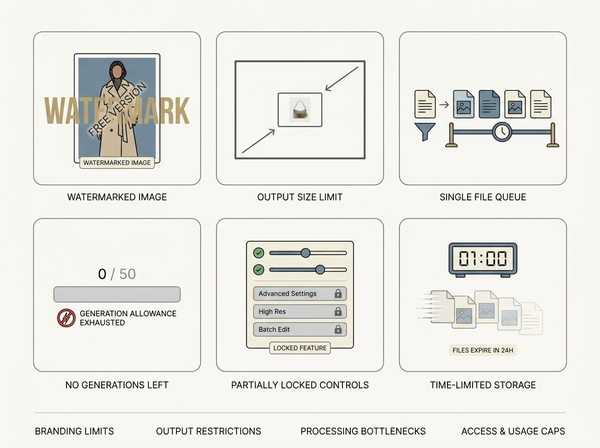
Limit | What it looks like | Why it exists |
Watermark | A mark across the image, sometimes only on download | The output demonstrates capability without being usable commercially |
Resolution cap | A file too small for listing zoom | Zoom resolution is what a merchant actually needs |
Batch and queue | One image at a time, slower processing at peak | Compute is the real cost, so it gets rationed |
Generation count | A monthly or daily allowance | Enough to evaluate, not enough to produce a season |
Feature gating | Pose control, reference locking or higher-fidelity modes withheld | The controls that make output repeatable are the paid product |
Retention | Outputs deleted after a period | Storage costs money and free storage invites abuse |
The pattern is consistent once you see it. Free gives you the generation and withholds the things that turn a generation into an asset: resolution, repeatability, volume and rights.
Feature gating is the one people underestimate. Pose control and reference locking are what let you produce a consistent set rather than a series of individually plausible images, and a catalog needs the set. A listing page where six colorways each sit slightly differently on the model reads as sloppy even to a customer who cannot say why.
Resolution is worth checking against a specific number rather than by eye. Marketplaces publish minimum dimensions for listing images and zoom behavior usually requires more than the minimum, so the question is not whether the free output looks sharp on screen but whether it clears the threshold your channel enforces. An image that looks fine in a browser tab can fail an upload check.
The limit that catches sellers out
Read the license before the feature list. Free tiers frequently grant personal or non-commercial use only, and a product image on a listing is commercial use by any definition — including on a marketplace, including for a small shop, including when the item does not sell.
This is not a footnote. Publishing an image you were not licensed to publish creates an exposure that sits with you rather than with the tool, and it survives the deletion of the image. Teams discover this at the point where someone asks for an audit trail, which is later than they would like.
Two specifics worth checking rather than assuming. Whether commercial rights attach to the free tier at all, and whether they attach retroactively to images generated on the free tier if you upgrade afterwards, since the second is often not the case. Both answers are in the terms, and both change what a free evaluation is worth.
What you can genuinely finish on a free tier
Some tasks fit inside those limits, not because free is better but because these tasks do not need resolution, volume or commercial rights in the first place.
• Checking whether your flat-lay photography is good enough, since a bad reference produces visibly bad output at any resolution and a watermark does not hide it.
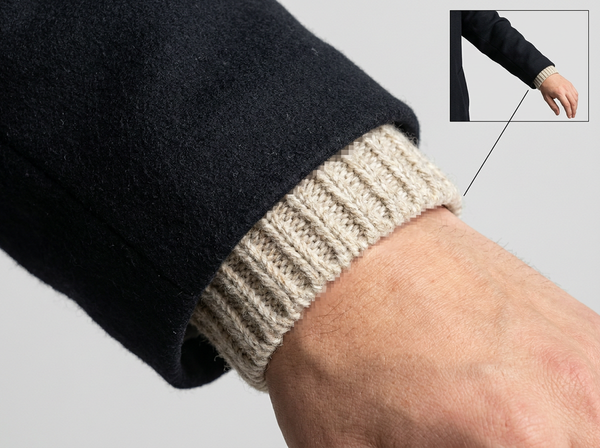
• Testing a difficult category — a cable knit, a plaid jacket, a sheer layer — to decide whether it belongs on this path before committing budget.
• Producing an internal mock for a merchandising meeting, where the image supports a decision rather than a listing.
• Comparing two model poses to see which suits your range, which is a judgment about your product rather than about the tool.
Each of these ends in a decision rather than an asset, which is exactly why the free-tier limits do not bite. Running a try-on anchored to your garment photograph on one hard garment answers more than reading any comparison, and the watermark is irrelevant when the output is going into a slide.
What paid tiers do not fix
Raising the ceiling on resolution and volume does not change anything upstream of the generation.
Input quality still decides the result. A flat-lay with a shadow across the print produces a wrong drape at any resolution, and paying more buys you a larger version of the same mistake. The failure modes are identical across tiers, which is why the free tier is a fair test of whether your references work — the one thing it does measure honestly.
Fit stays outside the system. No tier has your size chart, your garment measurements or a body scan, so a generated drape is a plausible guess whether or not you paid for it. Placing that image beside a size guide implies a relationship that does not exist at any price.
Color still needs a physical sample. A higher-fidelity mode narrows the gap; it does not close it, and no output should be the reference a buyer or a supplier matches to.
Review does not come with the subscription. Someone still has to hold the sample, check the placket, look at the pattern at the side seam and reject what fails. Paid tiers generate faster, which increases the volume arriving at a review step that most teams have not staffed.
Difficult categories stay difficult. Sequins, sheer layers, leather and heavily tailored garments do not become reliable at a higher price point, because the constraint is what a flat photograph contains rather than how much compute was applied to it. Why those categories fail the way they do is covered in how a clothes swap is actually computed.
Both tiers depend on the same thing
The single biggest determinant of output quality sits before either tier: the garment reference. Front, back, one construction detail, flat, evenly lit, in the right colorway. A wrinkle in the reference is read as structure rather than as a wrinkle, so it comes back as drape, which is why clearing it belongs to the source files rather than to a later pass — the same logic that makes flattening the garment before generation a preparation step rather than a fix.
This is worth saying plainly because it inverts the usual evaluation order. Most teams test tools against a fixed set of references. The more useful test runs one tool against references of varying quality, since that is the variable you control and the one with the larger effect.
The model image is the second shared dependency. Arms clear of the torso, a pose that suits the category, nothing crossing the chest — these determine how much has to be reconstructed, and the requirement does not soften on a paid tier. A team that fixes its references and its pose set before comparing anything will find the comparison easier and the eventual choice less consequential than expected.
Reading the terms without a lawyer
• Search the terms for the words commercial, resale and redistribution rather than reading start to finish, since those three words locate the clause that matters.
• Check whether rights are granted for outputs or only for use of the service, which is a distinction that decides whether you own the file.
• Look for whether an upgrade applies retroactively to work already generated, because assuming it does is a common and expensive mistake.
• Note the retention period, since an output you cannot re-download is an output you cannot re-use when a listing gets rebuilt.
None of this replaces advice from someone qualified to give it, and anything involving licensed artwork or a trademarked mark should go to counsel regardless of tier. The point is to know which question to ask before you commit a season to a workflow.
What this article cannot tell you
It cannot tell you what any particular tool’s free tier includes today. Tiers change frequently, and a limit accurate this quarter may not be next, which is why nothing above names a product or quotes a threshold.
It cannot tell you whether free is sufficient for your operation, because that depends on how many images you need, whether they go in front of customers, and what your licensing exposure looks like. Those are three questions about your business rather than about the tools.
It cannot make a free tier produce a listing-grade asset. Where the output is going to a customer, the requirements are resolution, consistency and clear commercial rights, and a tier that withholds any of the three is not a candidate regardless of how good the image looks on screen.
Frequently Asked Questions
Can I use free-tier output on a marketplace listing?
Only if the terms grant commercial rights, which many free tiers do not, and only if the file meets the platform’s image requirements for resolution and background. Both conditions have to hold. Check the license text rather than a feature comparison page, since the two are often written by different teams.
Does the watermark come off if I upgrade?
Sometimes, and sometimes only for images generated after upgrading. This is the same retroactivity question as licensing and has the same answer: it is in the terms, and assuming the generous version is the common mistake. Regenerating after upgrading is the safe path when the terms are unclear.
Is free-tier output lower quality, or just watermarked?
It varies, and the distinction matters. Some tiers apply the same generation and restrict only the output file; others withhold the higher-fidelity modes and the pose controls. The second kind gives a misleading impression of what the paid version does, in both directions.
How many free generations do I need to evaluate properly?
Fewer than most people use, if you test the right garments. One hard piece and one easy piece from your own range, run in that order, tells you more than twenty attempts on a sample image, because the answer you need is about your references and your categories rather than about the tool’s best case.
Should I evaluate on my own photos or the sample images provided?
Your own, always. Sample images are chosen to work, so they measure the tool’s ceiling rather than your floor. An evaluation on supplied samples answers a question you will never face again after the first day of production.
Is it worth paying if we only publish a few images a month?
That depends on where those images go rather than on the count. A handful of customer-facing listing images needs commercial rights and listing resolution, which usually settles it, while a handful of internal mocks does not. Decide by destination, not by volume.
The question to answer first
Free tiers answer one question well: do my references work, and does this category survive the process. That is a real question and worth the afternoon. What they do not answer is whether you can run a season on them, because the limits that matter — rights, resolution, repeatability — are the ones deliberately withheld. Test on your own hardest garment, read the license clause about commercial use, and decide from those two results rather than from a feature table.
Test the boundary before you commit a budget
Take one easy garment from your own range and one difficult one, and run them in that order. The easy one tests your references — if it fails, fix the photography before touching anything else. The difficult one tests the category boundary, which is the answer you actually need before committing a budget.Prepare three files for each: a front flat-lay, a back flat-lay, and a model image with the arms clear of the torso. Compare the two results against the physical samples, then read the commercial-use clause in the terms. Those two answers decide more than any feature comparison will.
→ Virtual Clothing Try-On — Style3D AI
Written by