Design Agents vs Tools: Where Verification Goes
An agent hides the intermediate steps, which is where verification used to happen. Which steps automate safely and which need a name.
A tool does one thing and hands it back. An agent takes a goal and runs several steps to reach it, deciding along the way what to do next.
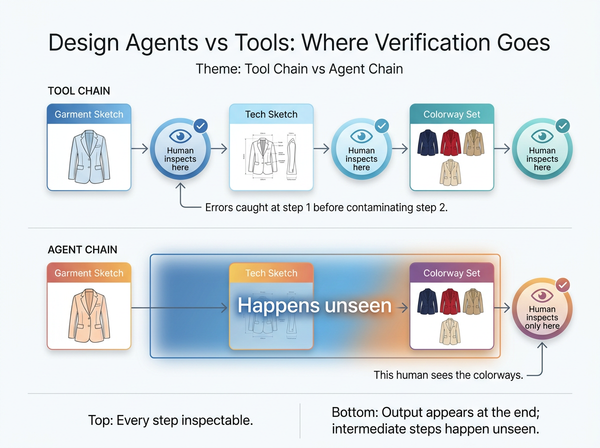
That difference sounds like degree — more automation, fewer clicks. It is structural, and the structure it changes is where a person looks at the work. In a tool-based process, output arrives after every step and someone can check it. In an agent-based one, output arrives at the end, and the steps in between happened without anyone seeing them.
What actually changes
The mechanics are less important than the consequence, which is that intermediate results stop being visible.
A garment image generated, then extracted to a flat, then turned into a set of colorways is three steps. Run as tools, each produces something a person can look at, and an error in the first step gets caught before it contaminates the second. Run as an agent, the first output becomes the second’s input automatically, and the person sees the colorways.
That is efficient when every step is reliable and expensive when any step is not. The colorways will be internally consistent with a flat that was internally consistent with a garment image nobody verified — a chain in which each link agrees with the one before it and none of them was checked against the physical garment.
Everything written across our other pieces about verification — checking against the sample rather than the source, catching an invented seam before it travels, verifying a base image before deriving variants — assumes somebody sees the intermediate. Multi-step automation is precisely the arrangement that removes that assumption.
The compounding problem
Errors in a chain do not add. They multiply, and they change character as they go.
An invented construction detail in step one becomes a specification in step two and a set of production files in step three. By the end it has been through processes that each treated it as given, and it now has the appearance of something that was decided rather than something that was guessed. The mechanism is the same one described in how a proposal quietly becomes a specification, running faster and with fewer places to intervene.
The practical version of this is that the cost of an early error scales with how many steps followed it. A wrong reference caught immediately costs a regeneration. The same wrong reference caught after a five-step run costs everything derived from it, plus the time spent establishing where the problem started.
Where agents genuinely fit
The pattern is that agents work where the steps are mechanical and the output is checkable at the end.
Format conversion, batch processing, applying an established rule across many files, producing variants from an approved source — in each of these, the intermediate steps have no judgment in them, so nothing is lost by not seeing them. The final output is checkable, and if it is wrong the fix is to correct the input and run again.
Agents also fit exploration, where nothing is being committed. Generating twenty directions from a brief is a multi-step task whose output is a set of options, and options get judged rather than trusted.
What agents fit badly is any sequence where a step involves a judgment about a physical object. Whether a seam exists, whether a color matches a sample, whether a drape is plausible for this fabric — these need a person with the garment, and automating past them does not remove the requirement, it removes the opportunity.
There is a version of this that catches teams who thought they were being careful. Reviewing the final output thoroughly feels like diligence, and it catches anything obviously wrong. What it cannot catch is an early error that every subsequent step processed faithfully, because the result of that is internally coherent — a clean, consistent, confident set of files describing a garment that is not yours. Thorough review of the wrong artifact is not the same as verification.
Design the checkpoints, not the automation
The useful question is not how many steps to automate. It is where a person has to look, and then automating everything between those points.
Three checkpoints cover most apparel workflows. After input preparation, because bad references produce bad everything and this is the cheapest place to catch them. After the first generation, because that output becomes the parent of everything downstream. And before publication, because that is the last point at which an error is still yours rather than a customer’s.
An agent running between those checkpoints is doing what it is good at. An agent running through them is removing the only three places the process could have caught something.
Where a run is genuinely long, an agent that stops and asks is more useful than one that finishes and reports. The pause costs less than the rework, and a workflow designed with deliberate stops is not a less capable workflow — it is one where the automation is placed against the actual risk.
What to require from an agent run
Two things, and they are the same two you would require from an outside contractor.
A record of what it did. Which references it used, which intermediate outputs it produced, what decisions it made when the instruction was ambiguous. Without this, a wrong result is not diagnosable and the same mistake recurs.
The intermediates themselves. Even where nobody looks at them during the run, keeping them means a problem found at the end can be traced to the step that caused it rather than triggering a full rerun. This is cheap to arrange and almost never arranged.
Where an agent is running a design sequence, or where a garment-focused sequence is doing the same work closer to production, asking what it will hand back besides the final file is a reasonable question to settle before relying on either for production work.
The judgment that does not automate
Underneath the workflow question is a simpler one about what these steps consist of.
Some steps are transformations: this file into that format, this color into that color. They have right answers, and automating them is straightforwardly good.
Other steps are decisions: whether this construction is what the garment should have, whether this colorway belongs in the range, whether this image represents the product accurately. These look like steps in a process and are actually judgments with commercial consequences, and an agent completing them has not made the judgment — it has produced the typical answer and moved on.
The distinction is not always obvious in advance, which is why it is worth doing on paper rather than discovering it during a run. Choosing a file format is a transformation. Choosing which of six generated options goes into the range looks similar in a workflow diagram and is a merchandising decision. Deciding whether a garment is on the same pattern block as another is a development judgment with cost attached, even though it arrives as a step in a sequence. Naming these while sketching the workflow takes minutes; discovering one was automated takes a season.
Sorting a workflow into transformations and decisions before automating it is worth an hour. The transformations can run unattended. The decisions need a name attached, and that requirement does not change because the tool got better at appearing to handle them.
What an agent cannot do
It cannot verify against a physical object. No step in any automated sequence has access to the garment, so anything requiring comparison to a sample remains a human step regardless of how the workflow is arranged.
It cannot tell you which step went wrong. Unless intermediates are retained, a bad final output is a single fact rather than a diagnosis, and diagnosis is what prevents recurrence.
It cannot make a judgment call. It can produce the answer that usually applies, which is different, and the difference is invisible in the output.
It cannot take responsibility for what gets published. Accuracy obligations sit with the seller regardless of how many steps ran automatically, which is worth stating plainly because a long automated chain makes it feel otherwise.
Frequently Asked Questions
What is the difference between an agent and a tool?
A tool performs one operation and returns it; an agent pursues a goal across several steps, choosing what to do next. The practical difference is that intermediate results stop being visible, which changes where verification can happen.
Are agents less accurate than tools?
Not per step. The risk is compounding: an unverified output becomes the next step’s input, so an early error travels and acquires the appearance of a decided fact by the end of the chain.
Which parts of an apparel workflow suit automation?
Transformations — format conversion, batch processing, applying an established rule, producing variants from an approved source. Anything requiring comparison to a physical garment does not, since no automated step can hold a sample.
How many checkpoints should a workflow have?
Usually three: after input preparation, after the first generation, and before publication. Automate freely between them and not through them, since those are the three places an error can still be caught cheaply.
What should I ask for from an agent run?
A record of what it did and the intermediate outputs it produced. Without the first, errors are not diagnosable; without the second, a problem found at the end means rerunning everything rather than fixing one step.
Is a longer chain always riskier?
Longer chains are riskier in proportion to how many judgment steps they contain, not how many steps they contain. A ten-step transformation sequence can be safer than a three-step one where the second step involves deciding something.
Should an agent ask questions mid-run?
Where the sequence is long or the inputs are uncertain, yes. A pause costs less than the rework it prevents, and a workflow with deliberate stops is one where the automation has been placed against the real risk rather than spread evenly.
Automate between the checkpoints
The framing that makes this manageable is not how much to automate but where a person has to look. Sort the steps into transformations and decisions, put a name on every decision, and let the automation run freely in the gaps. That produces a workflow where the efficiency is real and the verification is intact — as opposed to one where a long unbroken chain delivers a confident result assembled from steps nobody saw, which is the failure this technology makes easy and the reason to design against it deliberately.
Mark the decisions before you automate the steps
Write out the sequence you are considering automating and label each step as either a transformation — one right answer, no judgment — or a decision, meaning something with a commercial consequence that a person should own. Automate the transformations freely. Put a checkpoint after input preparation, after the first generation, and before publication, and require any agent run to hand back its intermediate outputs and a record of what it did, so a problem found at the end can be traced rather than rerun.
→ Fashion Design Agent — Style3D AI
Written by