
Reference to Video: More Dimensions, Each One Weaker
A reference clip supplies motion, tempo, camera, framing and mood at once. Name the one you want, and check for the ones you didn’t.
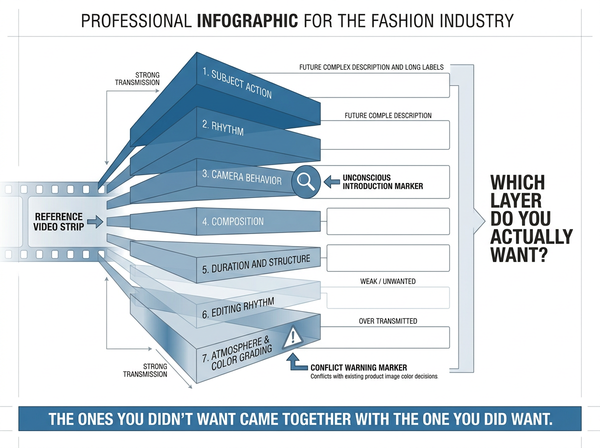
A reference image is one ambiguous instruction. A reference video is four or five arriving at once — how the subject moves, at what tempo, how the camera behaves, how long the whole thing lasts, and what the cutting rhythm is.
You almost always want one of those. The reference supplies all of them, weighted by whatever is most prominent, and the ones you did not mean come through alongside the one you did.
What a reference video carries
Dimension | What it means | Transfer |
Subject motion | The action itself — a turn, a walk, a gesture | Strong |
Tempo | Speed and energy of that action | Strong |
Camera behavior | Static, orbiting, pushing in, handheld | Moderate to strong |
Framing | How tightly the subject is held, headroom, crop | Moderate |
Duration and structure | How long, and whether it builds or loops | Moderate |
Cutting rhythm | Where and how often it changes shot | Weak and often unwanted |
Mood and grade | Light, color treatment, atmosphere | Variable, frequently over-transferred |
Motion and tempo are the strongest signals, which is convenient because they are usually what people are reaching for. Camera behavior transfers more than expected and is the dimension teams most often fail to notice they have imported.
Mood is the awkward one. A reference chosen for its movement can bring a color grade and a lighting feel with it, and those interact with a product image that has its own color decisions already made — which matters commercially if the garment’s colorway is what the customer is judging.
Motion belongs to the reference; drape belongs to your garment
The important separation is between the movement being copied and the fabric doing the moving.
A reference video shows a garment behaving a certain way because that garment had a specific weight and drape. Apply that motion to your piece and the action transfers while the fabric response is regenerated for your garment’s appearance — which is inferred rather than measured, for the reasons set out in why fabric movement is being guessed.
The practical consequence is that a reference cannot lend your garment the movement quality of the garment in the reference. If the reference shows silk flowing beautifully and your piece is a stiffer cloth, you get the action of that clip and a response your fabric would not produce, or a compromise between the two.
Choosing references whose garment is close in weight to yours is therefore not a stylistic preference. It reduces the distance the generation has to travel and produces results closer to what your piece would actually do.
Say which dimension you want
Since the reference supplies everything, the useful discipline is the same as with reference images: name the one thing it is for.
Wanting the turn, the pace, the way the camera orbits, or the length are four different intentions, and stating which one narrows what should carry. It also forces the decision to be made, which is the part that tends to be skipped when a reference “just feels right.”
Multiple references help here as well. Two clips sharing only the motion you care about make the common element unambiguous, in a way one clip conflating motion, camera, mood and cut cannot. The same logic applies as with still references, described in what a reference actually transfers.
Where the reference is doing its job well, working from a reference clip is faster than describing motion in words, since movement is genuinely hard to specify verbally and easy to point at.
There is a category of intention that references handle badly, which is worth recognizing early. Anything about the garment rather than the shot — how a hem should behave, how much a sleeve should swing — is not a reference question at all, because the reference cannot lend those properties. A clip communicates what happens in front of the camera; it says nothing about what your cloth will do when it gets there.
Teams reaching for a reference to communicate a fabric quality are usually reaching for the wrong instrument. A physical sample in motion, filmed on a phone for thirty seconds, communicates more about how a garment moves than any reference clip does, and it has the advantage of being about your garment.
Where reference clips come from matters
A reference is a piece of someone’s work, and using one as an input is a different act from being influenced by it.
Motion itself is generally not the protectable part — a model turning is not owned by anyone. What can carry exposure is the specific content: recognizable choreography, a distinctive campaign’s visual signature, music, and any identifiable person appearing in the clip.
Music deserves separate attention because it travels with a video file and is frequently the reason a clip was chosen. Audio rights are their own matter, and a reference used for motion should be stripped of its soundtrack rather than carried whole.
Where a reference is a competitor’s campaign, the same test applies as elsewhere: is the resemblance the appeal. Borrowing a camera move is ordinary practice; producing something a viewer recognizes as another brand’s film is a different position, and the generation step does not change it either way.
Your own past footage is the reference nobody uses enough, and it carries your camera language and your model direction without any of these questions attached. A brand that has filmed several seasons already owns a library of references that produce output looking like the brand — which is the outcome most teams are trying to reach by borrowing from someone else’s work.
It also solves a problem competitor references create. Using an outside clip repeatedly pulls a brand’s visual language toward whoever made it, gradually and without anyone deciding to, and the effect is only visible when a season is viewed as a whole.
Duration and the compounding problem
A reference clip’s length is not a target to match.
Longer generated clips drift, and a reference showing a fifteen-second sequence invites producing one, which is a request for more inference than the format supports. The useful approach is to take the motion from a reference and decide the duration separately, based on what the output can sustain rather than on what the reference happened to be.
Structure is worth separating from length too. A reference that cuts between shots is describing an edit, not a shot, and asking a generation step to reproduce an edit produces something that changes without a reason. Where an edited feel is wanted, generating the shots separately and cutting them is the ordinary way round.
Reviewing against the intention, not the reference
The review question is not whether the output matches the reference. It will, in the dimensions that transferred.
The question is whether it matches the intention — did you get the motion you wanted without importing the camera move, the grade and the pacing you did not. Comparing output to reference confirms transfer; comparing output to intention is the check that catches over-transfer, which is the characteristic failure here.
Then review the garment itself, at full speed and frame by frame, since everything true of generated clips generally is true of these. What the reference contributed does not change how the fabric response was produced.
What a reference video cannot do
It cannot lend your fabric another fabric’s behavior. The action transfers; the drape is regenerated for your garment, so a reference showing beautiful flow does not produce beautiful flow in a stiffer cloth.
It cannot indicate which dimension you meant. Motion, tempo, camera, framing, length and mood all arrive together, and nothing in the file marks which one was the point.
It cannot resolve the rights position of its own content. Recognizable choreography, identifiable people and music all travel with the clip, and none of it is assessed by the process.
It cannot make a long clip viable. Duration is a property of what the generation can sustain rather than of the reference, and matching a reference’s length is a common way to produce a clip that degrades.
Frequently Asked Questions
What transfers most reliably from a reference video?
Subject motion and tempo, which is fortunate since those are usually what people want. Camera behavior transfers more than expected, and mood and color treatment transfer unpredictably — often more than intended.
Can I get my garment to move like the one in the reference?
No. The action transfers, the fabric response is regenerated for your garment’s appearance. Choosing a reference whose garment is close in weight to yours narrows the gap but does not close it.
How many references should I use?
More than one where the intention is specific. Two clips sharing only the property you care about make that property unambiguous, while a single clip conflates motion, camera, framing and mood with no way to separate them.
Is it safe to use a competitor’s video as a reference?
Borrowing a camera move or a pace is ordinary practice; producing something recognizable as their film is not, and the generation step does not change that. Recognizable choreography, identifiable people and music each carry their own exposure — strip audio and get anything identifiable checked.
Should the output match the reference’s length?
No. Decide duration by what the generation can sustain, not by what the reference happened to be. Longer clips drift, and matching a reference’s length is a common way to produce one that falls apart.
What if the reference cuts between shots?
Then it is describing an edit rather than a shot. Generate the shots separately and cut them together, since asking a generation step to reproduce an edit produces changes without reasons.
How should I review the result?
Against your intention rather than against the reference. Matching the reference confirms that transfer happened; the failure here is over-transfer, and only comparing to what you actually wanted catches it.
Name the dimension, then check for the rest
A reference clip is a generous instruction — it gives you far more than you asked for, and the surplus is the problem rather than the benefit. Deciding in advance which single property the reference is for, choosing a garment close in weight to yours, and reviewing the output against that intention rather than against the clip turns a vague resemblance into a controlled input. The fabric response is still being generated whatever reference you use, so the reference improves the action and never the material.
Pick the dimension before you pick the clip
Decide which single property you want — the action, the tempo, the camera move, the length — and write it down before choosing a reference, since the clip will supply all of them and the ones you did not mean transfer alongside the one you did. Prefer references whose garment is close in weight to yours, use two clips sharing only that property where you can, and strip the audio. Then review the output against your stated intention rather than against the reference, because matching the reference is guaranteed and is not the question.
→ Reference to Video — Style3D AI
Written by