Fabric Design: What an Image of Cloth Leaves Out
Weight, stiffness, recovery and hand are absent from any fabric image. What to supply alongside it, and why two mills return two fabrics.
Generate a fabric and you get an image of a surface. Cloth is not a surface. It is a structure with a weight, a stiffness, a recovery and a way of falling, and the picture records one of those properties directly and the rest not at all.
That gap is why generated fabric looks convincing and behaves unpredictably. Everything a mill needs to make it, and everything a designer needs to know how it will hang, sits outside the frame.
A fabric is a construction, not a pattern
The visible surface of a woven cloth is a consequence of decisions that are not visible: which yarns, at what count, in what weave structure, at what density, with what finish applied afterward.
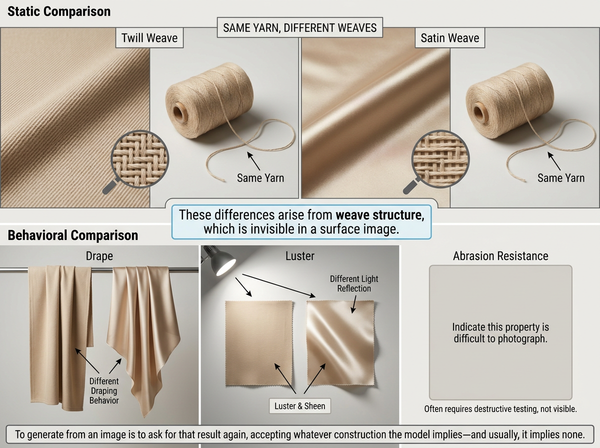
Two fabrics can look nearly identical and behave completely differently because those decisions differed. A twill and a satin can be woven from the same yarn and produce different drape, different sheen and different wear. A knit at two gauges reads similarly at a distance and does not behave the same on a body.
An image of a surface does not encode any of it. What it captures is the outcome — the visual texture that resulted from a particular construction — without the construction that produced it. Generating from an image reference means asking for that outcome again and accepting whatever construction the model implies, which is usually none in particular.
Which properties survive a picture, and which do not
Property | What it governs | Recorded in an image? |
Surface pattern | Visual appearance, print, weave texture | Yes |
Color | Appearance and colorway | Yes, imperfectly |
Apparent scale | How large the texture reads | Yes, if scale is stated |
Sheen | How light reflects | Partially, and lighting-dependent |
Weight | Drape, hang, how it falls | No |
Stiffness and recovery | Whether it holds a shape or collapses | No |
Opacity | Whether it needs lining | Sometimes visible, rarely reliable |
Hand | How it feels, which drives customer satisfaction | No |
Composition | Fiber content, care, performance | No |
The properties above the line are what an image is for. The ones below it are what a fabric is for, and they are the properties a garment’s success actually depends on.
This is the same limit that makes generated movement unreliable, described in why fabric movement is being guessed — movement is simply weight and recovery expressed over time.
Finish is the part that gets forgotten even by people who remember construction. A cloth is treated after it is made — brushed, calendered, coated, washed, given a hand-feel treatment — and those treatments change drape, sheen and hand substantially without changing the weave at all. Two lengths off the same loom can arrive as different fabrics. Nothing about a finish is visible in a design image, and it is frequently the difference between a sample that feels right and one that does not.
What a fabric design tool is actually producing
Being clear about the output prevents the common disappointment.
A generated fabric image is artwork. It is a design for a surface, usable as a print file, a reference for a mill, or a visualization of an idea. It is not a specification, and it does not become one by being detailed.
That distinction matters at the point of handover. A mill receiving a fabric image can match the appearance, and will make its own decisions about construction unless told otherwise — decisions that determine cost, drape and lead time. Two mills given the same image return two different fabrics, both of which look right.
Where the intention is a print on an existing base cloth, this is unproblematic: the base is specified separately and the image is genuinely the deliverable. Where the intention is a new cloth, the image is the beginning of a specification rather than the specification.
The properties that have to come from somewhere else
If an image cannot carry weight, structure and hand, those have to be supplied another way, and there are only three sources.
An existing fabric. Pointing at a cloth you already use — this pattern, on that base — is the fastest and most reliable route, since the base carries every property the image cannot.
A written specification. Fiber content, weight, weave or knit structure, density and finish, expressed in the terms your supplier works in. This is more work and is what a mill needs if the cloth is genuinely new.
A physical sample. Where the fabric is being developed, nothing substitutes for a hanger of it, and the earlier that exists the fewer assumptions travel downstream.
The failure mode is assuming the image did some of this. It did not, and a design approved on appearance alone commits a garment to a cloth nobody described.
Where generation genuinely helps
Surface design, which is a real and substantial part of the work.
Exploring pattern directions, developing a motif, testing scale, working out how a texture reads at garment size — these are appearance questions, and appearance is what the tool produces. The same applies to visualizing an existing fabric in a new colorway, where the construction is fixed and only the surface changes.
It also helps for communication. Showing a mill or a design director what you mean is faster with an image than a description, provided everyone understands they are looking at an intention rather than a specification.
Where a fabric direction is being explored before any construction is settled, generating fabric surface designs covers the visual half of the question quickly, leaving the physical half to be answered by a base cloth, a spec or a sample.
Scale is the error that survives review
One appearance property does get mishandled routinely, and it is worth separating from the others.
A fabric design has a physical scale — how large the texture or repeat is in centimeters — and an image on a screen has no inherent size. A design that looks correct on a monitor can be twice the intended scale on cloth, and the error is invisible until fabric arrives.
The consequence is a garment where the texture reads as coarse and cheap, or so fine it disappears, neither of which was the design. Stating the physical dimension alongside every fabric design, and viewing it at true scale against a garment panel, is the check — and it follows the same logic as repeat scale on prints, set out in how a repeat behaves at garment scale.
What fabric generation cannot do
It cannot specify a construction. Weave or knit structure, yarn count and density are what make a cloth behave as it does, and none of them are derivable from an image of the result.
It cannot tell you whether a fabric is producible. Whether a mill can make it, at what minimum, at what price and in what lead time are questions about a supply chain, and a convincing image can describe a cloth nobody will run.
It cannot predict hand. How a fabric feels is the property customers judge most immediately on arrival and the one furthest from anything an image contains.
It cannot support a content claim. Fiber composition, care instructions and any performance property stated on a label or in copy are claims with regulatory weight in most markets, and they come from testing and supplier documentation rather than from a design. An image describes an appearance and asserts nothing verifiable about what the cloth is made of.
It cannot substitute for a sample. Where a fabric is new, the first physical piece is where the design is actually evaluated, and no amount of visual development shortens that.
Frequently Asked Questions
Can I send a generated fabric image to a mill?
As a reference for appearance, yes, and it is a useful way to communicate an intention. As a specification, no — the mill will decide construction unless told, and two mills given the same image return two different fabrics that both look right.
Why does the fabric behave differently from what I expected? Because weight, stiffness and recovery are not in the image, and they are what determine behavior. The appearance was matched and the construction was chosen by someone else, or defaulted to whatever was typical.
What do I need to supply besides the image?
One of three things: an existing base cloth to apply it to, a written specification in your supplier’s terms, or a physical sample. The image covers appearance; something has to cover the rest.
Is generated fabric design useful at all, then?
For surface work, substantially. Pattern direction, motif development, scale testing and colorway visualization are appearance questions, and appearance is what it produces well. The limitation is only a problem when the output is mistaken for a specification.
How do I avoid scale errors?
State the physical dimension of the design in real units and view it at true scale against an actual garment panel rather than on a screen at arbitrary zoom. Scale is the appearance error that survives review and shows up when cloth arrives.
Does it work for knits as well as wovens?
The same limitation applies and is arguably worse, since a knit’s behavior depends heavily on gauge and yarn, and two knits that look alike at a distance can behave very differently on a body.
Should the fabric or the garment be designed first?
Whichever suits your process, but settle the base cloth’s properties before committing a garment silhouette to it. A silhouette that depends on drape and a fabric chosen on appearance is the combination that produces a disappointing first sample.
Design the surface, specify the cloth
The clean way to hold this is that a fabric design tool produces the visible half of a fabric, and the visible half is a real deliverable — prints, motifs, colorways and textures all live there. What it cannot produce is the half that decides how a garment made from that cloth will hang, feel and last, because none of that was in any image it learned from. Treat the output as artwork requiring a base cloth, a specification or a sample beneath it, and it does useful work. Treat it as a fabric and the first sample will explain the difference.
Attach the physical half before you approve the design
For every fabric design you take forward, name what supplies the properties the image cannot: an existing base cloth you already use, a written specification in your mill’s terms, or a physical sample in development. Then state the design’s real-world dimensions and view it at true scale against an actual garment panel, since scale is the one appearance error that passes review and only shows itself when the cloth arrives.
→ Fabric Design Agent — Style3D AI
Written by