
Shoes on a Model: Why Footwear Images Fail Differently
A wrong garment reads as odd drape. A wrong shoe reads as not standing on the floor. Contact, perspective and the ankle boundary.
A generated garment that goes wrong looks like a garment with an odd drape. A generated shoe that goes wrong looks like a shoe that is not standing on the floor.
The difference matters because everyone catches the second one. Reading drape takes some familiarity with clothing; reading contact with the ground takes none at all. A person who could not tell you what a princess seam is will still know, immediately, that something about that foot is wrong.
Footwear has a constraint clothing does not
A garment hangs. Its relationship to the body is soft, and a small error in that relationship reads as a fit question rather than an impossibility.
A shoe rests. It sits on a surface, bears weight, and casts a shadow where it meets that surface. Those three facts are not soft — they are governed by geometry that a viewer checks unconsciously and continuously.
That is why the failure mode is different. A slightly wrong sleeve reads as a slightly wrong garment. A slightly wrong contact shadow reads as a composite, and once a viewer sees a composite, everything else in the frame becomes suspect.
The three failures worth checking for
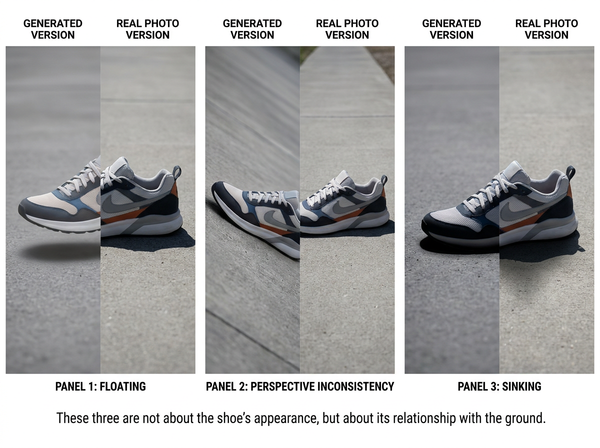
Floating. The shoe sits a hair above the surface, or the shadow beneath it is too soft, too even, or absent. The foot appears to hover. This is the most common and the most obvious.
Perspective disagreement. The floor recedes at one angle and the shoe sits at another. Both may be individually plausible; together they are impossible. A single shoe can hide this; two shoes cannot, which is the next section.
Sinking. The opposite error — the shoe reads as slightly buried in the surface, usually because the contact shadow is too dark or too tight against the sole. Less common than floating, and harder to name, but viewers register it as heaviness.
None of these are about the shoe’s appearance. They are about its relationship to the ground, and that relationship is generated rather than photographed.
Two shoes must agree with each other
A garment has one relationship to resolve: garment to body. Footwear has three: shoe to foot, shoe to ground, and left shoe to right shoe.
That third one is where generated footwear images most often break in ways that survive review. Each shoe can be individually convincing while the pair disagrees — one seen slightly more from above than the other, or two vanishing points that do not reconcile.
The reason this survives review is the same reason a generated side view survives review: the image is internally consistent with itself. A reviewer comparing the left shoe to the right shoe finds two plausible shoes. The disagreement is in the perspective, and perspective is not what people look at when they look at shoes.
The check is to ignore the shoes and look at the floor. Extend the ground plane mentally, or with a line, and see whether both soles sit on it. Where the pair disagrees, one of them will be off that plane.
The ankle is footwear’s version of the cuff
Where a shoe ends and a leg begins is a boundary with a variable in it: the sock, or the absence of one.
A low-cut shoe on a bare ankle produces one kind of edge — skin meeting a stiff material along a curve that changes with the pose. A shoe over a sock produces three materials in a short run of pixels, which is the same structural problem described in why layered looks are harder, transposed to the foot.
Boots make it worse and easier at once. Worse, because the shaft interacts with the trouser or the calf along its whole height rather than at a point. Easier, because a boot covering the ankle removes the sock variable entirely.
The practical consequence is that ankle boots and low-cut styles are harder than they look, and knee-high boots are easier than they look. That inverts most people’s expectations about which is the simple case.
Material behaves differently on a shoe
Everything true about specular surfaces in apparel is more acute in footwear, because footwear uses more of them and uses them on curved, structured forms.
Patent leather has a highlight band that follows the curve of the toe box and moves with the viewing angle. Suede has a nap with a direction, so the same material reads lighter or darker depending on which way it is brushed. Mesh is semi-transparent over a structured shape, which means the edge is not an edge at all. Metallic and iridescent finishes shift hue across the surface.
Each of these is a property that a flat photograph records as one instance of, and that a generated image reproduces as the version those materials usually have. On a garment, that error reads as a fabric slightly off. On a shoe, where the material often is the product, it reads as a different shoe.
Where the material is the reason someone is buying, the close view belongs to photography — the same logic set out in what a detail shot is being asked.
There is a second-order effect worth naming for anyone planning a shoot. The ground plane in the base photograph determines what every derived angle can do, so a session shot on a defined surface — a visible floor, a consistent horizon — gives generation something to reconcile against. A session shot on a continuous backdrop with the floor removed gives it nothing, and every generated angle inherits that ambiguity. The decision costs nothing at the time and constrains everything afterwards.
Where generated footwear images earn their place
Not every shoe image is a hero image, and the useful split is by what the image is doing.
Colorway variants of an approved style are a good use. The construction is fixed, the geometry is already resolved in the base image, and only the surface changes.
Secondary angles on simple, matte styles work reasonably — a canvas sneaker or a matte leather boot has fewer specular traps than a patent heel.
Lifestyle and context images, where the shoe is part of a scene rather than the subject of scrutiny, are lower risk because nobody is examining the contact shadow in a mood shot.
Where a shoe needs to be shown on a model in a controlled way, generating the try-on from your own product shots covers this range, provided the base photography resolved the geometry properly in the first place.
Photography stays necessary in four places regardless of how good the generation gets.
The main image, on any style where the shoe is the product. It carries the contact, the perspective and the material all at once, and it is the image a customer will look at longest.
Anything specular — patent, metallic, iridescent, high-shine synthetic. The highlight is the product’s character and it is exactly what gets generated as a default.
Anything where the sole is visible or claimed. Tread patterns, colored midsoles and branded outsoles are content rather than consequence, and a generated version invents them.
Any style where the ankle boundary is the design — an unusual collar height, a distinctive topline, a visible lining edge. That boundary is where generation is weakest and where the design is most specific.
What footwear generation cannot do
It cannot establish fit. This is the same limit as apparel, and it is more consequential here, because footwear fit is dimensional rather than approximate. A shoe either fits or it does not, and no image contains a length or a width.
It cannot show how a shoe wears. Creasing across the toe box, how the heel counter holds, how the material relaxes — these appear after wearing and are the properties customers ask about in reviews.
It cannot resolve the ground it was never given. If the base photograph had an ambiguous surface, or was shot against a continuous backdrop with no floor plane, there is nothing to reconcile the shoe against, and every generated angle inherits that ambiguity.
It cannot make a pair agree by itself. Left and right are generated as parts of one image, not as two objects placed in a shared space, and their agreement is something to check rather than something guaranteed.
Frequently Asked Questions
Why do generated shoes look like they are floating?
Because the contact shadow is generated rather than observed, and a generated shadow tends to be softer and more even than a real one. Real contact is a hard, small, dark area directly under the load-bearing part of the sole, with a softer falloff around it.
Are boots easier or harder than sneakers?
Knee-high boots are usually easier, because they remove the ankle boundary and the sock variable. Ankle boots and low-cut styles are harder than they look, since the shoe-to-leg edge changes with every pose.
What is the fastest check on a footwear image?
Ignore the shoes and look at the floor. Extend the ground plane and see whether both soles sit on it. Perspective disagreement between the pair is the failure most likely to pass review.
Can I use generated footwear images for a main listing image?
For colorway variants of a style whose geometry was resolved in a real photograph, often yes. For a new style, a specular material, or anything where the sole or the ankle detail is part of the design, photograph it.
Does the model’s pose matter for footwear?
More than for garments. A pose that puts weight on one foot changes the contact, the shadow and the material creasing on that shoe, and a generated pose change is regenerating all three. Standing poses with even weight are the safest.
Does this apply to bags and hats as well?
The underlying issue is shared — accessories interact with the body and with gravity in ways a garment does not — but each has its own version of it. Footwear’s is contact with the ground; a bag’s is weight and contact with the body; a hat’s is the boundary with hair. The checks do not transfer directly.
How do I check a pair against each other?
Look for two things: whether both soles sit on the same ground plane, and whether both shoes are seen from the same height. Individually convincing shoes with disagreeing viewpoints is the characteristic failure here.
Look at the floor, not the shoe
The instinct with a footwear image is to examine the shoe, and the shoe is usually the part that is fine. What breaks is the relationship — to the ground, to the leg, and between the two shoes — and none of those relationships were photographed. They were inferred, from a reference that recorded one instance of one of them. Checking the floor first, then the ankle, then the pair, catches most of what actually goes wrong, and it takes less time than looking closely at a shoe that was never the problem.
Check the ground plane before anything else
For every generated footwear image, extend the floor line mentally and confirm that both soles sit on it — perspective disagreement between the pair is the failure that most reliably survives review. Then check the contact shadow: real contact is a small, hard, dark area under the load-bearing part of the sole, not an even soft pool. Then check the ankle, where the shoe meets skin or sock. Photograph anything specular, anything where the sole is visible, and any style whose topline is the design.
→ Virtual Shoe Try-On — Style3D AI
Written by