
Garment Detail Shots: The Image Customers Actually Zoom Into
The detail shot is the only image customers magnify. What it’s being asked, what must never be generated, and where the error direction hurts.
Every other image on a product page gets glanced at. The detail shot gets magnified, because it is the only one that answers the question the customer is actually asking, which is whether the garment is worth what you are charging for it.
That makes it the image with the most evidentiary weight and the least tolerance for invention — and it is also the image where invented content is hardest to spot, because texture at high magnification is exactly what generation produces convincingly.
What a detail shot is being asked
A customer looking closely at a cuff is not admiring the cuff. They are running a set of proxy checks: does this fabric look like what the description claims, is the stitching regular, does the hardware look substantial, is the trim the quality the price implies.
Those checks are how people decide whether a listing is honest. A product page with good detail images reads as confident; one without them reads as hiding something, which is why the images matter even to customers who do not consciously inspect them.
The consequence is that a detail shot is a claim. A close-up of dense, even stitching says the garment is well made in a way no sentence in the description does, and it will be verified when the box is opened.
Zoom is where generation shows
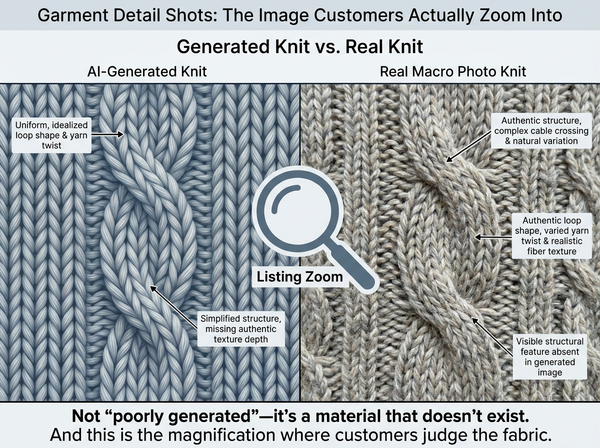
Detail shots live at the magnification where synthesized texture stops being convincing to anyone paying attention.
A generated knit produces a knit texture. It is not your gauge, not your yarn, not your stitch, and at listing zoom a customer looking specifically at the fabric is looking at a material that does not exist. The mechanism behind this — why generated and enlarged texture is plausible rather than recovered — is covered in what upscaling actually adds to an image, and it applies with more force here because the whole purpose of the image is close inspection.
The same applies to stitch density, seam finish, edge treatment and the way a hem sits. Each is a manufacturing property, and each gets generated as the version that typically accompanies garments of that appearance.
What makes this risky rather than merely imperfect is the direction of the error. Generated detail tends to be neat, even and well-resolved — better than average manufacturing rather than worse. The image flatters, the garment arrives, and the gap is in the direction customers notice.
What must be photographed, without exception
Some content in a detail shot is not aesthetic. It is identity, and generating it produces something between an inaccuracy and a legal problem.
Brand marks, woven labels and any logo hardware belong in this category. A generated logo has plausible letterforms, which is precisely the failure mode nobody catches at a glance and everybody notices on the physical item.
Care labels and content labels carry regulated information. Fiber content, care symbols and country of origin are claims with legal weight, and an image showing a legible label that says something slightly other than what the label says is a problem of a different class from a slightly wrong texture.
Licensed artwork and third-party marks belong here too, and for the same reason: the obligation attached to reproducing them accurately does not relax because the reproduction was generated.
The rule worth writing into a process is simple. If the detail is something a customer could hold up against the physical item and find different, and if that difference would matter to them or to a lawyer, it gets photographed.
What a detail shot should show, by category
Category | The detail that decides the sale | Generate or shoot |
Knitwear | Gauge, yarn character, rib and cuff finish | Shoot |
Tailoring | Buttonhole quality, lapel roll, lining finish | Shoot |
Denim | Topstitch color and density, hardware, selvedge if claimed | Shoot |
Basics and jersey | Neckline finish, hem stitching | Either, with review |
Outerwear | Zip quality, storm flap construction, quilt lines | Shoot the hardware, either for panels |
Leather and suede | Grain, edge finish, hand | Shoot |
Sheer and lace | Transparency, edge treatment | Shoot |
Occasion and embellished | Bead or sequin attachment, density | Shoot |
The pattern is that anything sold on material or workmanship needs photography for the close view, which is the same logic that governs which garment types survive image-based generation applied to a smaller frame.
Where a category’s detail shot is genuinely generic — the hem stitching on a plain jersey tee — generating the close view covers volume without carrying much risk, and it frees the photography budget for the styles where the close view is the argument.
The price-point problem
Detail shots do more work at higher prices, and the exposure scales with them.
At low price points, a customer’s expectation is calibrated by the price itself, and a slightly flattering detail image sits within what they anticipated. At higher prices, the detail shot is a substantial part of the justification, and a gap between the image and the item reads as misrepresentation rather than as disappointment.
This inverts a common assumption about where to save on photography. The instinct is to shoot the expensive styles and generate for the cheap ones, and that is directionally correct — but the reason is not cost recovery. It is that the higher the price, the more the customer is buying the properties a photograph records and a generation invents.
Close images are also not only read by customers. Wholesale buyers, marketplace reviewers and, in some categories, compliance checks all use them, and each reads for something different.
A buyer looking at a detail image is assessing whether the garment will sit at the price you are asking in their store, which is a judgment about workmanship rather than about appeal. A generated detail that flatters produces an order placed against a garment that arrives differently, and that conversation is more expensive than a returned unit.
Marketplace review, where it happens, is checking that the image represents the product. Detail images are a common place for that check to land, because they are the images where a specific claim is visible enough to test.
None of this changes what a detail shot should show. It changes how much weight the decision carries, since the same image is doing several jobs at once and the least forgiving audience sets the standard.
Consistency across a detail set
A product page usually carries several detail shots, and they have to look like they came from the same session.
Lighting is the tell. Detail images generated independently arrive with slightly different light direction and quality, and a set where the cuff is lit from the left and the hem from the right reads as assembled rather than photographed — even to a viewer who could not say what is wrong.
Scale is the second. Detail shots at inconsistent magnification make a garment hard to read, since the customer cannot tell whether a stitch is fine or the crop is tight. Deciding a standard magnification per garment type does more for a listing’s clarity than any individual image.
Where detail images are being produced alongside generated views, both belong in the same review pass, since inconsistencies between images are more visible than flaws within one.
What generated detail shots cannot do
They cannot show your manufacturing. Stitch density, seam finish and the character of a specific yarn are outcomes of a factory and a specification, and none of them are derivable from a photograph of the garment’s overall appearance.
They cannot reproduce a mark accurately. Anything typographic, small and identity-bearing degrades in ways that read as legible and are not exact.
They cannot support a material claim. Where copy states a fiber, a weight or a construction, the detail image is the evidence for it, and a generated image is evidence of nothing.
They cannot be verified against the source photograph. A generated detail will agree with the garment shot it came from, since it was derived from it. Verification requires the physical piece under a loupe or a macro lens, which is the only comparison that means anything.
Frequently Asked Questions
Can I generate detail shots for a listing?
For generic details on simple garments, with review. For anything sold on material or workmanship — knitwear, tailoring, leather, embellishment — the close view is the evidence for the price, and it needs photography.
Why does the generated texture look wrong to me but not to my team?
Because you know the garment. A generated texture is plausible for the category and specific to nothing, so it reads as fine to anyone without the physical piece in hand and as clearly wrong to anyone who has held it. That is a useful review test in itself.
What about logos and labels?
Always photograph them. Generated type is legible and inexact, which is the worst combination, and care and content labels carry regulated claims where inaccuracy is a different class of problem than a soft texture.
How many detail shots does a listing need?
Enough to answer the questions a customer has at that price. A basic tee needs few; a coat at a serious price needs the closure, the lining, the cuff and any distinguishing construction. Judge by what the price implies rather than by a fixed count.
Does the detail shot need to match the main image exactly?
It needs to be the same garment in the same colorway under comparable light. Detail shots that disagree with the main image on color or texture undermine both, and the disagreement is more noticeable than either image being slightly off alone.
Is macro photography worth the setup?
For categories where material is the product, yes, and it does not require much. The requirement is consistent light and a fixed magnification standard rather than expensive equipment.
What is the fastest way to check a generated detail image?
Hold the garment. Everything else — comparing to the source photo, reviewing on screen, asking a colleague — confirms internal consistency without touching accuracy.
The image that gets inspected
Most product images are seen; the detail shot is examined. That difference should decide where photography goes, because it is the frame where a customer is deliberately looking for evidence and where generated content is most convincing and least true. The practical split is not complicated: generic details on simple garments can be generated, anything sold on material or workmanship gets photographed, and anything carrying a mark or a regulated claim gets photographed without exception. Applied consistently, that costs a fraction of a full shoot and removes the category of complaint that starts with a customer holding the item next to your listing.
Decide by what the customer is checking
Go through the range and mark, for each garment, the one detail that justifies its price — gauge on a knit, buttonhole and lining on tailoring, hardware on outerwear. Photograph that one. Add every logo, woven label and care label to the photograph list regardless of category, since generated type reads as legible and is not exact. Then set a standard magnification and a consistent light direction per garment type, so the detail set looks like one session rather than several.
→ Garment Detail Shots — Style3D AI
Written by