
Bags on a Model: The Weight That Isn’t in the Picture
A generated bag hangs; a real bag is being carried. Straps that sit rather than press, soft bags that hold a shape they shouldn’t.
A generated bag hangs. A real bag is being carried, and the difference between those two things is visible in a way most people notice without being able to name.
The strap does not press into the shoulder. The body does not lean, even slightly, against the load. The fingers around a top handle are not gripping anything. The bag itself holds its shape as though it were empty, or made of something stiffer than it is.
Every one of those is a consequence of weight, and weight is not in the reference
photograph.
A bag is carried, not worn
This is the structural difference from apparel, and it produces a different set of failures.
A garment is supported by the body along its whole contact area. The relationship is distributed and forgiving, and a small error reads as a fit question.
A bag is supported at a point or two — a shoulder, a hand, a forearm — and everything else about it is a response to gravity acting through that point. Change the point and the whole object behaves differently. There is no distributed contact to average the error out.
That concentration is why bag images give themselves away at specific places rather than generally. The strap, the contact with the body, the shape of the bag itself, and the hand. Four locations, and a reviewer who checks those four catches most of what goes wrong.
The strap is the first tell
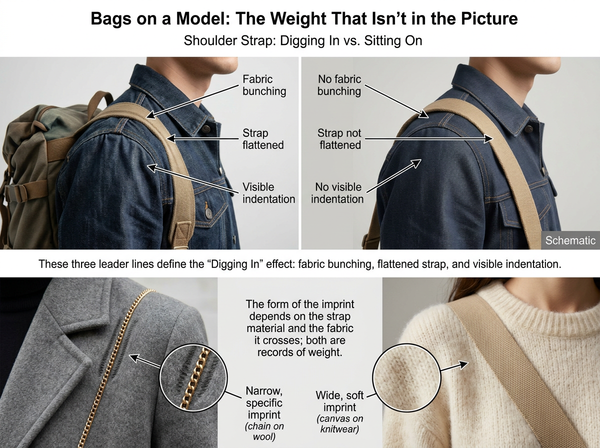
A loaded strap deforms the shoulder and is deformed by it. Fabric bunches slightly under it, the strap flattens where it crosses, and on a coat or knit there is a visible compression line that follows the strap’s path.
A generated strap usually sits on the shoulder rather than into it. It reads as placed rather than bearing.
The severity depends on what the strap is made of and what it is crossing. A thin chain strap over a structured wool coat leaves a specific, narrow impression; a wide canvas strap over a knit leaves a broad, soft one. Both are records of weight, and both are generated as approximations of what straps usually look like on shoulders.
There is a related problem for crossbody styles. A crossbody strap runs across the torso and interacts with everything it crosses — a lapel, a placket, a print. That is the same class of problem as a layered look, described in why layered looks are harder, with the added complication that the strap is under tension and the garment beneath it is not.
Soft bags hold a shape they should not
Structured bags — a box bag, a rigid tote, anything with a frame — are the easy case. Their shape is a property of construction rather than of load, so a generated version has less to invent.
Soft bags are where the weight problem becomes visible. A hobo, a slouchy tote, an unlined leather shoulder bag: their silhouette is produced by what is inside them and by how they are hanging. Empty, they collapse. Loaded, they take a shape that depends on the load.
A generated soft bag tends toward a tidier version of that silhouette — fuller than empty, neater than loaded, with folds that are evenly distributed rather than concentrated where the contents actually sit.
This is the same directional error described across our other pieces: generated output flatters. A tidier bag looks like a better bag, so nobody rejects it in review, and the customer opens a box containing something that slumps.
Hands are doing something
A hand on a top handle is not resting there. It is gripping, and grip is visible — in the tension across the knuckles, in how the fingers wrap, in the small compression of the handle itself.
A generated hand tends to be placed rather than engaged. The fingers curve around the handle without closing on it, and the handle stays perfectly round.
Hands are also, independently, the part of a generated figure that people examine without deciding to — a point that matters for whole image sets, as covered in what has to agree across a set. In bag imagery those two problems compound: the hand is both the most scrutinized element and the one doing the most work.
Where the bag is held in the crook of an arm, or tucked under one, the same logic applies to that contact. It is a load-bearing relationship, and load is what is missing.
Two contact cases are worth separating from the strap, because they behave differently. A bag held in the crook of an elbow is being clamped rather than hung, so the deformation is on the bag rather than on the body, and a soft bag will show a distinct crease where the arm holds it. A bag worn on the back changes the problem again: the straps are symmetrical and under even load, and the failure moves to whether the two sides agree with each other — the same pairing check that footwear needs between left and right.
Which bag images are safe to generate
The pattern is that risk rises with softness and with how much of the bag’s character comes from being carried.
Structured styles in matte materials, shot on a model in a static pose, are the low end. The bag’s shape is its own, the contact points are few, and there is little for the generation to get wrong beyond the strap.
Colorway variants of an approved style sit here too. The geometry, the contact and the drape were resolved in the base photograph, and only the surface changes.
The high end is soft, unstructured bags in specular materials — patent, metallic, high-shine coated leather — where the silhouette is load-dependent and the surface is light-dependent at the same time.
Where the style and the use fall into the safer half, generating the try-on from your own product photography covers the volume without asserting much about how the bag behaves under load.
What to photograph
Anything soft, because the silhouette is the product and the silhouette comes from the load.
Anything where the hardware is a selling point. Clasps, chain links, branded feet and lock mechanisms are small, typographic in the relevant sense, and generated versions of them are plausible rather than exact.
Anything where the interior is part of the pitch. Lining, pockets and organization cannot be inferred from an exterior photograph at all, and a customer who cares about them will look for that image.
Any style where the strap or handle is a design feature rather than a component. An unusual chain, a knotted handle, an adjustable system — these are content, not consequence.
What bag generation cannot do
It cannot show capacity. How much a bag holds is a dimensional fact, and no image contains it. The common workaround — a model carrying it with visible contents — is exactly the case where the load has to be inferred.
It cannot show how the material ages. Leather softening, corners scuffing, a bag developing its shape over months are the properties bag buyers ask about most in reviews, and they are furthest from anything a photograph records.
It cannot resolve weight from an unloaded reference. If the base photograph shows the bag empty on a surface, there is no information about loaded behavior to carry into a worn image, and every generated result is an assumption about what is inside.
It cannot make hardware exact. The same limit that applies to logos and small type applies to a clasp: legible, plausible, and not necessarily yours.
Frequently Asked Questions
Why do generated bag images look slightly wrong on the shoulder?
Because the strap sits on the shoulder rather than into it. A loaded strap compresses the fabric it crosses and flattens where it bears, and both of those are records of weight that the reference photograph did not contain.
Are structured bags easier than soft ones?
Considerably. A structured bag’s silhouette comes from its construction, so there is less for generation to invent. A soft bag’s silhouette comes from the load, and the load is exactly what is missing.
What should I check first on a bag image?
Four places: the strap where it crosses the body, the bag’s silhouette, the hand or arm carrying it, and any hardware. Those four are where the weight problem shows, and checking them takes less time than assessing the image as a whole.
Why do the hands look off?
Because a hand on a handle is gripping, not resting, and grip is visible in the knuckles and in the small deformation of the handle. Generated hands tend to be placed rather than engaged, and hands are also the part people examine without deciding to.
Does this apply to shoes and hats as well?
The underlying problem is shared across accessories — they interact with the body and with gravity in ways a garment does not — but each has its own version. Footwear’s is contact with the ground; a bag’s is load; a hat’s is the boundary with hair.
How much does the model’s pose matter?
More than for a garment, because the pose determines where the load goes. A hand on a hip with a bag on that shoulder produces a different strap line, a different body lean and a different bag position than a relaxed stance. Changing the pose regenerates all three.
Should the bag be shown empty or full?
Whichever matches how it will be sold, and be consistent about it across the range. What causes trouble is a base photograph of an empty bag used to generate worn images, since the worn behavior then has no source.
Look at the load path
The useful habit with a bag image is to trace where the weight goes. From the bag, through the strap or handle, into the shoulder or the hand, and out through a body that is holding it. Every point on that path should show a response — compression, tension, a slight lean — and in a generated image most of them will not, because the weight that would produce them was never recorded. That trace takes a few seconds and finds more than any amount of looking at the bag itself, which is usually the part that came out fine.
Trace the load path before you approve the image
For every generated bag image, follow the weight from the bag through the strap or handle and into the body, and check each point for a response: the strap pressing into rather than sitting on the shoulder, fabric compressing where it crosses, fingers closing on the handle rather than curving near it, and a silhouette that matches whether the bag is meant to be full or empty. Photograph anything soft, anything where the hardware or the interior is part of the pitch, and any style whose strap is a design feature rather than a component.
→ Virtual Bag Try-On — Style3D AI
Written by