Why Hats Look Wrong in Generated Model Photos
Which parts of a hat image to photograph and which to generate, and why the hat-and-hair boundary decides whether the picture reads as real.
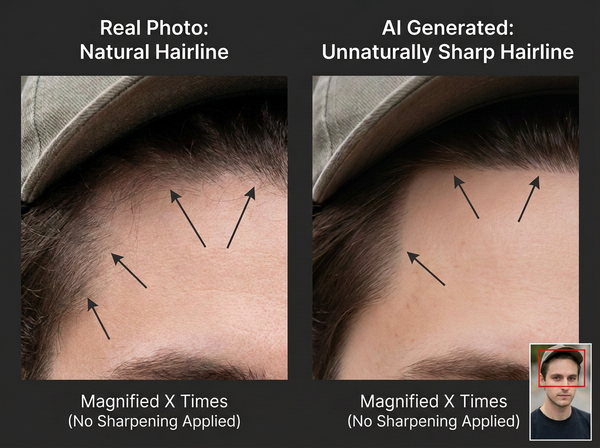
A generated hat image usually fails in one place, and it is not the hat. The crown reads correctly. The color matches. The brim has the shape your product has. What gives the image away is the narrow band where the hat stops and the hair starts: the hairline at the front, the shadow the brim drops across the forehead, and the way hair leaves from under the back edge. Reviewers rarely name this. They say the picture looks edited, then either approve it anyway or send it back without instructions, and the same failure ships again the following month.
Hats concentrate a problem that runs through all generated apparel imagery. An edge is never a line. In a cutout, that fact is a decision about pixels which already exist. In a generated hat image, those pixels do not exist at all — the boundary has to be invented, and it has to be invented in a way that agrees with a head your model actually has.
Three boundaries meet under one brim
Wherever a hat meets a head, three different problems land on top of each other.
l The hairline is a gradient of individual hairs against skin, and the brim usually crosses it.
l The brim casts a shadow onto the forehead and the eyes, which is a lighting boundary rather than a material one.
l Hair exits from under the hat at the temples and the nape, where strands travel from fully hidden to fully visible within a short distance.
None of the three is a line, and all three interact. The shadow lands across the hairline, so an error in the shadow reads to the viewer as an error in the hair. Strands leaving the back edge catch the same light as the brim above them, so a hard exit and a soft brim shadow contradict each other. Getting one of the three right while the other two stay wrong still produces an image that reads as assembled.
A cutout decides, a generation invents
An earlier piece on clean cutout edges argued that an edge is a band rather than a line: at the boundary of hair, a pixel is part subject and part background, and the honest question is what proportion. That is an interpretation problem. The information is present in the file; the work is to read it correctly.
A hat placed onto a model reverses the situation. The strands that would cross the brim, the density of hair at the temple after the crown compressed it, the way a part shifts when a hat is pulled on — none of that exists in either input. It gets constructed. Construction sits at a lower bar than interpretation, because the result has to be plausible rather than correct.
That lower bar produces error with a consistent direction. Invented hair is tidier than real hair: fewer strays, more even density, a cleaner part, an exit band that looks combed. Nobody sends an image back for looking neat, so this failure passes review every time it appears. Neatness at the junction is therefore something a reviewer has to look for on purpose, not something that will announce itself.
Where the hat sits on the head
Two seating errors account for most of the hat images that get rejected without a clear reason. Sitting too high, the hat reads as perched — an object resting on hair rather than a garment being worn. Sitting too low, it reads as jammed on: the hairline disappears, the ears take pressure, the face shortens.
Both come from the same missing information. How deep a hat sits is a relationship between the interior of the hat and the volume of hair beneath it, and neither of those is visible in a photograph of the hat lying on a table. A beanie swallows a cropped head and rides high on a thick one. A stiff brim rests on the skull; a soft one settles onto hair and takes its shape. The hat try-on in Style3D AI takes a photograph of the hat and an image of the model and returns the hat placed on that head, which means the seating depth you see was inferred from those two pictures rather than measured from your sample.
The check that catches a seating error is not another look at the image. It is a comparison against the hat on a real head, ideally the head of whoever wears your fit sample, because that person knows how far down it goes and will say so immediately.
The brim shadow has to agree with the rest of the frame
A brim shadow is the most readable lighting cue in a portrait, because it lands on a face and faces are what viewers read most carefully. Its direction states where the key light is. Its hardness states how large that source was. Its color states what the fill was doing.
This is where compound edits break. If the hat is placed in one operation and the background is replaced in another, each step infers the lighting on its own, and nothing forces the two inferences to match. Replacing the scene behind a model is itself a judgment about light direction and color temperature, and the brim shadow on the face is where the disagreement between the two steps becomes visible first. Decide which operation owns the lighting decision, and check the face against the new background before you check anything else.
Hairstyles are not equally hard
Hair worn under the hat | What has to be invented | Where it breaks first |
Cropped close to the scalp | Almost no exit; the hairline crossing the brim is the whole problem | The hairline reads as drawn rather than grown |
Long and worn down | A long exit band on both sides, plus strands that pass in front of the brim | Strand direction changes across the band, or hair that belongs in front sits behind |
Curly or coiled with volume | How the volume compresses under the crown and recovers below it | Volume survives untouched under the hat, which no worn hat allows |
Gathered or tied back | The transition from covered hair to a gathered shape at the nape | The gather starts exactly where the hat ends, with no compressed section between |
Fringe across the forehead | A hair band and a shadow band occupying the same region | The brim shadow lands on the fringe as though it were skin |
A head covering worn under the hat | Fabric meeting fabric, with layer thickness showing at the edge | The two layers read as one, or the hat sits at the wrong depth |
This ordering is our reading of the failures, not a measured result. Run your own product photographs through it before treating it as a rule, because categories differ and so do the reference images you feed in.
What these images cannot do
l They cannot show whether the hat fits a buyer’s head, because fit is a relationship between two circumferences and the picture contains only one head.
l They cannot stand in for the interior measurement on your supplier’s spec sheet, which is the only thing that answers a sizing question.
l They cannot show the inside of the hat, so the sweatband, the lining, the seam finish and the sizing tape all have to be photographed.
l They cannot show how a crown creases after a season of wear, or how a stiff shape deforms on head shapes other than the one in the image.
One further limit deserves its own sentence, because it gets missed. An image of a hat on one hairstyle is evidence about that combination and nothing wider; if the buyer’s hair is nothing like the hair in the picture, the picture has not told them what they came to find out. A distorted crown in the input photograph also stays distorted, since placement works from what it was given. The product photograph remains the ceiling on the result.
How to review one before it ships
Review in the opposite order from the one people use naturally. The hat is what everyone looks at first, and it is the part most likely to be right; the junctions are what nobody looks at, and that is where the failures live. Open the image at the size your product page renders it, never in a contact sheet, then work through the hairline, the exit at the temples and the nape, and the shadow on the forehead before you look at the hat itself.
Verify against the object rather than against the source photograph. A generated image and the picture it came from will always agree, so comparing them confirms errors instead of finding them. Put the physical hat on a real head under similar light and look at the same junctions in that order.
Whether these are placed by hand or generated with the hat try-on in Style3D AI, keep the original hat photograph in the review packet. A reviewer who cannot see what the brim looked like before placement has no way to separate an inference from a fact.
Common questions
Why does the image look fine in the grid and wrong on the product page?
The failing region is small, and a thumbnail throws it away before anyone can see it. Product pages render at a size where the hairline and the exit band are legible, and zoom viewers go further. Review at the largest size the page will use, not at the size of your review sheet.
Can we generate hat images on a model whose hair was not visible in the original photo?
Hair that was hidden or cropped in the input has to be constructed from nothing, which is the hardest version of this task. The output will be plausible, and it will also be tidier and more even than that person’s actual hair. Choose inputs where the hairstyle you want is already visible, and treat hidden hair as a shooting requirement rather than a generation setting.
Should we still photograph hats on a real head?
Photograph the evidence that generation cannot supply: the interior, the seating depth on a head you can measure, and the way the material creases with wear. Generate the variations around that proven shape — other scenes, other poses, other colorways. The shoot answers questions about the product; generation answers questions about presentation.
The hair under the hat looks too neat. Can we just ask for messier hair?
You can push the output in that direction and it usually helps a little. The error has a consistent direction toward tidiness, though, so it belongs in your review criteria rather than in a prompt you write once and forget. A reviewer comparing hair density against the same model’s other photographs will catch it more reliably than any instruction will.
Does it matter whether we place the hat before or after replacing the background?
It matters, because each operation infers the lighting independently and the brim shadow on the face is where a mismatch surfaces. Decide which step owns the light direction, then check the shadow on the face against the new background before approving anything else in the image.
Do we need a separate image for every hairstyle we sell to?
An image is evidence about the combination it shows, so the question is whether hairstyle changes what the buyer is judging. For a structured brim, the shape reads much the same across hair types and one image carries the point. For a beanie, or anything that takes its shape from what sits underneath, more than one is worth shooting or generating.
What the image is really being asked to prove
A hat image carries two claims at once: that this object exists and looks like this, and that it belongs on a head. The first is a photography problem, and generation handles it well. The second is a boundary problem, and boundaries are where invented pixels are least accountable to anything outside the picture. Which is why the review that matters is not a review of the hat. It is a review of the band around it — hairline, exit, shadow — where the image either agrees with how heads and hair behave, or quietly does not and leaves the buyer to notice.
Check your last hat image at the junction
Open the most recent hat photograph you published and view it at the size your product page renders. Look at the hairline first, then at the point where hair leaves the back edge, then at the shadow on the forehead — and only after that at the hat. If the hair sits more evenly than the same model’s hair does in your other images, the picture is making a claim your product cannot support, and that claim will scale into every variation you generate from it.
→ Hat try-on: https://www.style3d.ai/ai-photoshoot/virtual-hat-try-on
Written by