
When Product Images and Copy Disagree
Shoppers who spot a contradiction between the photos and the description do not pick a side. They discount the page. How the two halves drift apart.
A shopper who finds a contradiction on a product page does not investigate it. They do not decide that the photograph is right and the description is wrong, or work out which one to trust. They stop treating the page as a source of information. The claim they were checking becomes unanswerable, and so does every other claim on the page, including all the ones that were accurate.
That is the part worth understanding. An earlier piece argued that a set of images is the unit of trust rather than any single image. Copy belongs inside that unit. The photographs, the description, the size chart and the bullets under the price are read as one statement made by one seller — never as separate departments, even though separate departments are usually how they were made.
A page is read as one statement
Production splits a product page along ownership lines. A studio or a generation pipeline produces images. Merchandising, an agency or a copy tool produces text. Someone else assembles the two. The buyer sees none of that structure and has no reason to imagine it, so a disagreement between the halves does not read as two teams working from different information. It reads as a seller who is not being careful, or not being straight.
The cost of the disagreement is larger than the cost of either error alone. An image that flatters the drape is an error a buyer might absorb. Copy that overstates softness is an error a buyer might forgive. The two together stop being a question about the garment and become a question about the seller, which is a much more expensive question to have raised on a page whose job is to close a decision.
There is an asymmetry that makes this worse over time. Copy is cheap to change and images are expensive, so when the two disagree, the text gets edited. Edit it often enough and the description stops describing the product and starts describing the photographs. A page in that state can be perfectly consistent with itself and still wrong about the object in the warehouse, which is the version of the problem nobody catches in review.
Where the two sides contradict each other
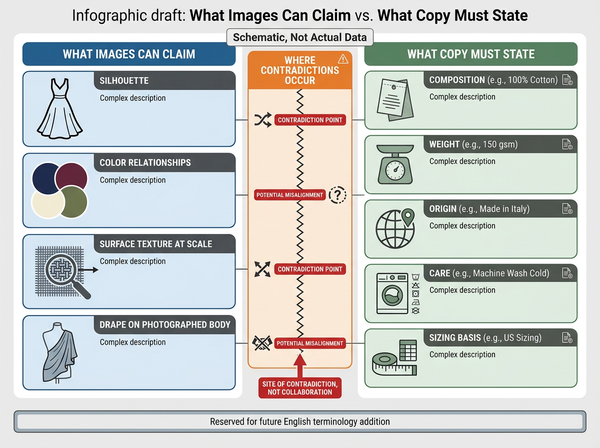
Claim area | What the image asserts | Where copy usually goes wrong |
Drape and body | The silhouette the garment holds on a body, under studio light and with styling help | Soft, fluid or relaxed language applied to a garment the images have made structured |
Color | A color under one lighting setup, alongside whatever the retouch pass did to it | Named shades and undertone words that the image cannot confirm and the buyer’s screen will not honor |
Surface | Texture at the scale the crop shows, after any retouching | Hand feel and slub or grain descriptions that were written from a swatch, not from the shot |
Fit | How this garment sits on this one body in this one pose | Fit language that reads as a promise across sizes and body types |
Weight and thickness | Almost nothing, since weight is not visible | Lightweight or substantial claims that the images quietly contradict through opacity and stiffness |
Generated images concentrate every row in that table, because generation errs in a consistent direction: drape comes out more structured, surfaces come out tidier, prints come out better aligned, and the model stands better. Copy written honestly from a physical sample will therefore disagree with a generated image more often than it disagreed with a photograph, not less. That is not a reason to avoid generation. It is a reason to stop writing copy from approved images.
Which side is allowed to make which claim
An image can carry what is a consequence of the object being what it is: silhouette, the relationship between colors in a print, how a surface behaves at a given scale, how the garment sits on the body that was photographed. It cannot carry anything that exists independently of appearance — composition, fabric weight, origin, care, the basis of the sizing, how the seams hold up after washing. Those are known because somebody measured them or was told them by a supplier, and no photograph, generated or not, is evidence for any of them.
Both sides cross this line in opposite directions. Copy invents appearance when it describes drape that the writer never handled. Images imply fact when lighting and retouching make a fabric read as something more expensive than it is. The second one is harder to catch, because nobody wrote a false sentence.
The working rule that follows is narrow and worth enforcing: write copy from the sample and the spec sheet, never from the approved image set. A sentence in the description that cannot be traced back to a sample, a supplier document or a measurement is decoration, and decoration is where the contradictions start. A try-on image settles appearance rather than fit, and the same division applies to every other claim on the page.
Claims about composition, origin, care and sizing also carry regulatory weight in ways that vary by market and by platform. Treat those lines as owned by whoever holds compliance in your organization, and verify them market by market and platform by platform rather than reusing a description across regions because the garment is the same.
Sequence is part of the claim
The first image sets the question the rest of the page is answering. A hero shot on a body makes the buyer ask about fit and drape; the images that follow are read as the seller’s response to that question, and a flat lay in second position answers something else. A hero on a flat surface makes the buyer ask about construction and color, and a styled group shot next reads as a change of subject.
Order is therefore an argument, not a display preference, and copy sits inside the same sequence. A description that opens on fabric feel after a hero that opened on silhouette is answering a question the buyer has not asked yet. The PDP layout tool in Style3D AI arranges a set of approved images into a page order, which means it works from whatever the set contains: a missing detail shot stays missing, and an image that contradicts the copy will be placed just as neatly as one that supports it.
What a product page cannot do
• It cannot settle fit, because fit is a relationship between a body and a garment and the page has access to only one of them.
• It cannot make an unphotographed property true by describing it, and the description carries the whole risk when the property turns out to be wrong.
• It cannot be repaired by layout, since arrangement changes the order in which a contradiction is read, not whether it is there.
• It cannot tell the buyer which half is wrong, which is exactly why the buyer discounts both halves instead of picking one.
One more limit belongs here even though it sits above the page. Trust is granted to a seller, not to a listing, so a contradiction found on one page is information about every other page in the catalog. This is judgment rather than a measured effect, and it is the judgment behind treating page review as a standing process rather than a launch task.
Reviewing the page as one artifact
Put the final images and the final copy in front of one person at the same time, with the physical sample in the room. Reviewing them in separate tools on separate days is what produced the disagreement in the first place, and it is the cheapest thing on this list to fix.
Then run the review in both directions. Read each adjective in the copy and name the image that supports it; an adjective with no supporting image is either an unsupported claim or a missing shot, and both outcomes are useful. Reverse it afterward: look at each image and say out loud what a buyer would conclude from it, then check whether any line of copy contradicts that conclusion.
Verify against the sample rather than against the image set. Images and the copy written from them will always agree, so comparing those two confirms the drift instead of finding it. The person doing this review should own neither the photography nor the text, because the reviewer’s job is to see the page the way someone who has never seen the garment sees it.
Common questions
Should the copy be written before or after the images?
Write it from the sample and the specification, which usually means it can start before the shoot and should not wait for the images. Writing after approved images arrive is the mechanism that turns a product description into a caption. If the copy has to change once the images exist, treat that as a signal to check the images against the sample, not as a routine edit.
What if the photograph is accurate and the copy is the problem?
Fix the copy, and then find out why it said what it said. A description that overstates softness usually came from a supplier sheet, a previous season’s page or a writer working from images, and each of those sources will produce the same error on the next listing. The fix that matters is at the source, not on the page.
Can generated copy be used for the description?
Generated copy can describe what is visible in an image, which means it can help with appearance language and structure. It cannot supply composition, care, origin or sizing basis, because those facts are not in the image and nothing in the generation process can check them. Those lines have to come from your supplier documentation and be reviewed by whoever owns compliance.
How much of the description should map to a specific image?
Every claim about appearance should map to one, and claims that are not about appearance should map to a document instead. That mapping is the review artifact worth keeping, since it makes an unsupported adjective visible before publication rather than after a return. Claims that map to nothing are the ones to delete first.
Does this apply to marketplace listings where the layout is fixed?
The fixed layout removes your control over sequence but not over the statement, and the same pairs still contradict each other in the same places. Where the platform decides the order, the remaining lever is which images exist and what the copy claims, so the review is the same and the layout section simply does not apply to you.
Who should own the final check?
Someone who owns neither the images nor the copy, and who can hold the sample while reading the page. Ownership of the check matters more than seniority, because the reviewer’s value comes from having no reason to defend either half. In a small team, the person who handles returns is often the best reader of this document you have.
What the page is asking the buyer to believe
A product page makes one claim with many parts: this object exists, it looks like this, and these are its properties. Images carry the middle part and can carry only that. Copy carries the third part and is answerable for it. When the two disagree, the buyer is not being asked to choose between them — they are being told that the seller did not check, and that is the claim that gets remembered. Consistency on the page is not a style standard. It is the only evidence a stranger has that the rest of what you wrote is true.
Read your page the way a stranger reads it
Pull up your highest-traffic listing with the physical sample next to you. Read each adjective in the description and name the image that supports it, then look at each image and say what a buyer would conclude from it. Anything on either side that the other side contradicts is worth fixing before you touch traffic or pricing, and anything the sample contradicts is worth fixing today.
→ PDP layout: https://www.style3d.ai/ai-photoshoot/ai-fashion-pdp-layout
Written by