
Model Photoshoot Sets: One Shoot, Many Images, One Problem
Customers judge the set, not the image. What has to agree across frames, why chaining drifts, and where expansion stops paying.
A customer does not look at a product image. They look at a product page, which is a set of images, and they form an impression from the set rather than from any single frame.
That is the whole difficulty with expanding one shoot into many. Each generated image can be individually convincing while the set as a whole reads as assembled — and “assembled” is a thing people perceive immediately and cannot articulate, which makes it hard to catch in a review that looks at images one at a time.
A set is a claim that these were taken together
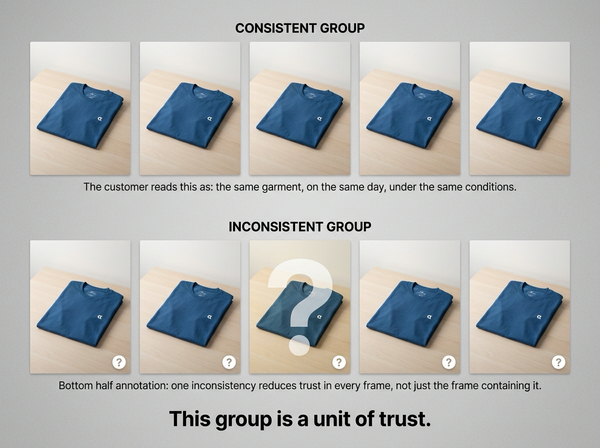
Product images carry an implicit assertion: this is the same garment, photographed on the same day, under the same conditions. Everything the customer concludes about color, fit and quality depends on that assertion holding.
Break it and the damage is not localized. A gallery where one image is slightly warmer than the others does not read as one bad image; it makes the customer uncertain about the color in all of them. The set is the unit of trust, so an inconsistency degrades every frame rather than the frame containing it.
This is why set-level review matters more than image-level review, and why teams that check each output carefully and never lay them side by side keep shipping galleries that feel wrong for reasons nobody can name.
What has to agree
Property | Why it matters | How it usually breaks |
Color temperature | Decides the garment’s apparent color | Independently generated frames drift warm or cool |
Light direction | Sets where shadows fall | Each frame lit from wherever the generation put it |
Light quality | Hard or soft shadows read as different sessions | Mixed across a set without anyone noticing |
Camera height | Changes body proportion | Varies when frames are produced separately |
Focal length feel | Alters perceived depth and silhouette | Inconsistent compression between frames |
Garment state | Same wrinkles, same hang, same styling | Each frame re-infers the drape |
Model appearance | Skin tone, hair, expression, stance | Small drifts that read as different people |
Background | Tone and evenness | Slight differences that make the set look pasted |
The properties customers name when something is wrong — color, fit — are usually not the properties that broke. Light direction and camera height do most of the damage while being the things nobody looks at directly.
Lighting is the tell
Of everything on that list, light direction is what people register first without knowing they registered it.
Human perception is efficient about this. Shadows that fall left in one image and right in the next signal two separate events, and the conclusion lands before any conscious inspection. A viewer scrolling a gallery does not think “the key light moved”; they think the page looks cheap.
The check takes seconds. Put the set in a row and look only at where the shadows fall — under the chin, beside the sleeve, on the ground if there is contact. If the direction changes, the set will read as assembled regardless of how good each image is.
Color temperature runs a close second, and it has a compounding problem: it also changes the apparent colorway. A set drifting warm across three frames is both inconsistent and inaccurate about the product.
One anchor, never a chain
The reliable structure for a set is a single verified anchor image with everything derived from it.
The failure mode is chaining — generating a second image from the first, a third from the second — because each step inherits the previous step’s inferences and adds its own. Three steps in, the drape and the lighting have drifted somewhere nobody chose, and the last image agrees with the one before it rather than with the garment.
Deriving everything from one anchor keeps errors independent instead of cumulative. It also makes correction tractable: if the anchor is wrong, everything gets regenerated, which is a clear decision rather than a search for where the drift started.
The same principle governs pose sets specifically, where the drape changes with every variation, as covered in what a pose change does to the garment. It applies to angles too, where an inferred view derived from another inferred view compounds twice over — described in which angles can be inferred.
The anchor itself should be photographed. An entire set derived from a generated anchor has no point of contact with the physical garment at all.
The model has to stay the same person
Where a set shows one garment across several frames, the model is part of what asserts a single session.
Small drifts are the problem rather than large ones. A visibly different face gets caught; a marginally different jawline, a slightly different hair fall, a shifted skin tone across three frames produces a set that feels off without any frame being identifiably wrong.
The check is the same as for lighting: side by side, looking at one property. Face, then hair, then hands, then stance. Reviewing whole images invites the eye to assess overall quality, which is not the question.
Where a set deliberately shows several models, the requirement inverts: the models vary and the garment must not. Every frame has to agree about hem length, sleeve length and how much ease the garment has, because that is the information a customer is assembling across the set.
Hands deserve a note of their own. They are the part of a generated figure people examine without deciding to, they interact with the garment in ways that change from frame to frame, and they are frequently where a set gives itself away. A review pass that checks faces and skips hands misses the most common tell.
Where expansion stops paying
Generating more images is close to free and reviewing them is not, so the economics turn at a point most teams pass without noticing.
Each additional image needs checking against the anchor and against the rest of the set, and set-level review does not parallelize the way generation does — the whole set has to be looked at together, by someone with the garment available. Doubling the images roughly doubles that work while the generation cost stays flat.
There is a second cost that arrives later. Every image in a set is something that has to be regenerated when the anchor is corrected, re-checked when the garment is re-sampled, and replaced when the season’s presentation standard changes. A large set is a larger maintenance obligation, and that obligation is invisible at the moment of generation, which is when the decision gets made.
The practical consequence is to decide the number of images per listing deliberately rather than producing what the tool makes easy. A tight set that a reviewer can genuinely check beats a large one reviewed superficially, since the failure mode of the large set is exactly the inconsistency that set-level review exists to catch.
Where the set size is settled and an anchor is verified, expanding a photographed anchor into the rest of the set covers the volume that would otherwise be studio time.
What set expansion cannot do
It cannot make a set consistent by itself. Each frame is generated against the anchor, not against the other frames, so agreement across the set is something to check rather than something produced.
It cannot substitute for a photographed anchor. A set derived entirely from generated material has no verified relationship to the garment at any point, and every frame inherits whatever the first inference got wrong.
It cannot answer questions the shoot did not. If the original session never showed the back, the garment’s proportions on a body, or how it moves, expansion produces more images that also do not show those things.
It cannot reduce review effort. Expansion moves work from the studio to the review step, which is usually the more constrained of the two and rarely gets resourced when the shooting budget goes down.
Frequently Asked Questions
Why does my gallery look wrong when every image looks fine? Because the set is the unit customers perceive, and inconsistency in light direction, camera height or color temperature degrades all the frames rather than one. Review the images side by side and look at one property at a time rather than assessing each image as a whole.
How many images should a listing have? Enough to answer the customer’s questions and few enough that someone can genuinely check the set against the garment. Producing more than can be reviewed properly reintroduces exactly the inconsistency the review exists to prevent.
Should I generate images from each other or from one source? From one source, always. Chaining compounds each step’s inferences into the next, so by the third image the drape and lighting have drifted somewhere nobody chose and the errors are no longer independent.
Does the anchor image need to be a photograph? Yes, if the set is going on a listing. A set derived entirely from generated material never touches the physical garment, so there is no point at which anything can be verified.
What is the fastest way to review a set? One property at a time across all images: shadow direction, then color temperature, then hem level, then the model’s face. Reviewing image by image invites judgment about quality, which is a different question from whether the set holds together.
Can I show several models in one set? Yes, and it changes the requirement rather than removing it. When models vary, the garment must not — hem length, sleeve length and ease have to agree across every frame, since that is what the customer is assembling from the set.
Is a bigger set better for conversion? Not reliably, and it costs review capacity that is usually scarcer than image production. A smaller set that is consistent and answers the real questions is a safer bet than a large one where nobody has checked whether the frames agree.
The set is the product page
Everything that makes expansion attractive — many images from one session, at almost no marginal cost — pushes toward the failure that matters, which is a gallery that reads as assembled. The corrective is not more careful review of individual frames. It is reviewing the set as a set, from a photographed anchor, at a size somebody can actually check. Teams that decide the number of images by what they can verify rather than by what they can generate end up with pages that look photographed, which is the only impression any of this is trying to produce.
Review one property across all frames
Photograph one anchor image, derive every other frame from it rather than from each other, then lay the whole set out and check one property at a time: where the shadows fall, then color temperature, then hem and sleeve level, then the model’s face and hands. Reviewing images individually invites a judgment about quality, which is not the question — the question is whether these look like they were taken together. Set the number of images by what a reviewer can genuinely check with the garment in hand.
→ AI Model Photoshoot — Style3D AI
Written by