
AI-driven 3D fashion modeling transforms design concepts into lifelike digital garments in record time. With Style3D AI, designers can convert sketches into 3D assets, simulate fabrics, and visualize collections virtually. This method minimizes waste, accelerates production, and empowers brands to launch fashion lines with precision, creativity, and efficiency.
How can AI accelerate 3D fashion modeling?
AI enhances 3D fashion modeling by automating silhouette generation, fabric simulation, and fitting from sketches or photos. It reduces repetitive manual steps and enables instant virtual testing. With Style3D AI, designers can generate ready-to-use 3D garments for virtual showcases, marketing visuals, and production planning.
Table: Key Advantages of AI in Fashion Modeling
| Benefit | Impact |
|---|---|
| Faster Prototyping | Converts ideas to 3D garments in minutes |
| Lower Costs | Minimizes physical samples |
| Sustainability | Reduces fabric waste |
What are the core benefits of AI-powered 3D model creation in fashion?
AI shortens the design cycle, cuts material costs, and encourages creative freedom. Designers can experiment with new textures, colors, and silhouettes without waste. Platforms like Style3D AI provide simulation tools that help refine designs with accuracy and reduce reliance on traditional sample-making.
How does Style3D AI integrate with existing workflows?
Style3D AI seamlessly connects with fashion design pipelines, importing sketches, patterns, and fabric data. It exports production-ready models compatible with rendering and game engines. This integration allows teams to collaborate efficiently while maintaining consistency across stages—from concept design to marketing.
How do you start with a 3D AI model from a sketch?
Start with a refined sketch or mood board, then use AI conversion to create a base 3D silhouette. Adjust fabric physics and lighting for realism. Style3D AI offers intuitive presets and templates that simplify the process, helping users turn creative visions into market-ready assets.
Table: Steps to Transform Sketches into 3D Garments
| Step | Description |
|---|---|
| 1 | Import sketch into AI system |
| 2 | Generate 3D silhouette |
| 3 | Apply fabric physics and color |
| 4 | Render and refine |
How to optimize textures and materials in AI 3D design?
Texture optimization uses AI to map realistic fabrics, adding micro-details and depth. Style3D AI’s fabric presets help designers achieve visual consistency across garments. By simulating wear, sheen, and scale, users ensure their 3D pieces look authentic and production-ready.
How does AI handle pattern creation and sewing details?
AI creates patterns based on measurements, assembles seam lines, and simulates stitches automatically. Style3D AI allows users to manage pattern replication and size grading efficiently, ensuring accurate fits and faster development for entire collections.
How to set up a virtual try-on for AI 3D garments?
Virtual try-on allows designers to view fit and drape on digital avatars. Style3D AI supports avatar imports, custom body measurements, and live previews. This feature helps brands test different body types and visualize motion before any physical sample is made.
How to capture and present AI 3D models for marketing?
Use photorealistic renders, animations, and lifestyle scenes to display designs. Style3D AI provides templates for lookbooks and marketing campaigns. Maintaining consistent lighting, textures, and branding ensures cohesive visuals across digital channels.
How to ensure quality and scalability in AI 3D workflows?
Consistency and scalability depend on structured QA and version control. Within Style3D AI, teams can establish templates, approval workflows, and review cycles to maintain quality across seasons. Automated validation ensures every model meets production standards.
How does Style3D AI facilitate collaborative design?
Style3D AI promotes real-time collaboration, enabling multiple users to co-create, comment, and edit projects. Integrated version tracking ensures transparency and reduces rework. This centralizes fashion development and streamlines approvals, improving communication between creative and production teams.
Style3D Expert Views
“Style3D AI is redefining how fashion teams conceptualize and deliver collections. By merging AI-powered drafting with photorealistic simulation, designers gain freedom to innovate while maintaining production precision. Studios using Style3D AI report faster approvals, fewer physical samples, and enhanced storytelling across digital channels. It’s not just design acceleration—it’s the future of collaborative creativity.”
Has AI 3D design changed fashion production timelines?
Absolutely. AI dramatically shortens design-to-sample cycles. What once took weeks can now be achieved in hours. Brands adopting Style3D AI deliver seasonal lines faster, with improved accuracy and minimal waste. The technology streamlines every phase—from ideation to digital retail.
Conclusion
AI-driven 3D fashion design reshapes the industry by merging speed, sustainability, and creativity. Style3D AI empowers designers to move from sketches to 3D garments efficiently, simulate fabrics accurately, and showcase collections with realism. The path to modern fashion success lies in adopting AI-powered workflows that optimize quality, collaboration, and scalability.
FAQs
How can designers start creating AI 3D fashion models efficiently?
Begin with AI 3D modeling tools, import garment sketches, define fabric properties, and generate base structures. Refine fit and textures, then render outputs. Use 2D visualization tools like Style3D AI for fast apparel previews and marketing visuals, noting it supports design imagery, not 3D modeling.
What are the best tools for AI driven fashion design workflows?
Top tools include AI modeling software, rendering engines, and visualization platforms. Combine 3D tools for structure with 2D solutions like Style3D AI for fashion design visualization and marketing images, ensuring faster presentation and reduced production costs.
How do you achieve realistic 3D garment rendering with AI?
Focus on fabric simulation settings, lighting accuracy, and texture mapping. Use high resolution materials and adjust physics parameters for realism. Post process renders for polish, then complement outputs with 2D marketing visuals for campaigns.
Can AI replace traditional fashion prototyping methods?
AI enhances but does not fully replace traditional prototyping. It reduces sampling needs and accelerates iteration. Designers still validate fit physically, while AI handles visualization and early stage refinement efficiently.
How does AI improve fashion design workflow efficiency?
AI automates pattern generation, rendering, and visualization, reducing manual tasks. It enables rapid iteration, better collaboration, and faster approvals, helping brands move from concept to presentation significantly quicker.
What is the role of AI in fashion marketing visuals?
AI enables high quality apparel imagery creation without photoshoots. Tools like Style3D AI generate polished marketing visuals, campaign assets, and e commerce images, improving speed and consistency across branding.
How can fashion brands use AI for e commerce product images?
Use AI to generate product ready visuals, adjust styling, and create multiple variations instantly. This reduces costs while maintaining quality, helping brands scale content production and improve conversion rates.
Is Style3D AI a 3D garment modeling tool?
No. Style3D AI is a 2D fashion design and marketing visualization tool, not a 3D modeling solution. It specializes in fast apparel design images and marketing visuals, helping brands create professional content efficiently without focusing on 3D garment construction.
Written by
What's Next?
How to Turn Photo to 3D for Free: A Complete Guide
Turning a photo into a 3D model for free is easier than ever with AI platforms like Style3D AI. You can transform 2D photos into lifelike 3D garments, accessories, or avatars, edit textures, and create virtual photoshoots—all without expensive tools. This guide explains how to start your Style3D AI-powered photo-to-3D workflow step by step. How do you convert a photo to a 3D model for free? To convert a photo into a 3D model for free, begin with a clear 2D image and use AI reconstruction toolHow Video to 3D Model AI Transforms Fashion Design and Production
Video to 3D model AI accelerates fashion innovation by transforming simple video footage into detailed 3D assets that designers can reuse, edit, and animate. This technology, integrated into Style3D AI, enables faster design validation, lifelike virtual fittings, and reduced production costs. It helps brands move efficiently from concept to consumer-ready designs through automated, AI-driven workflows. How does video to 3D model AI work for fashion? Video to 3D model AI reconstructs garments
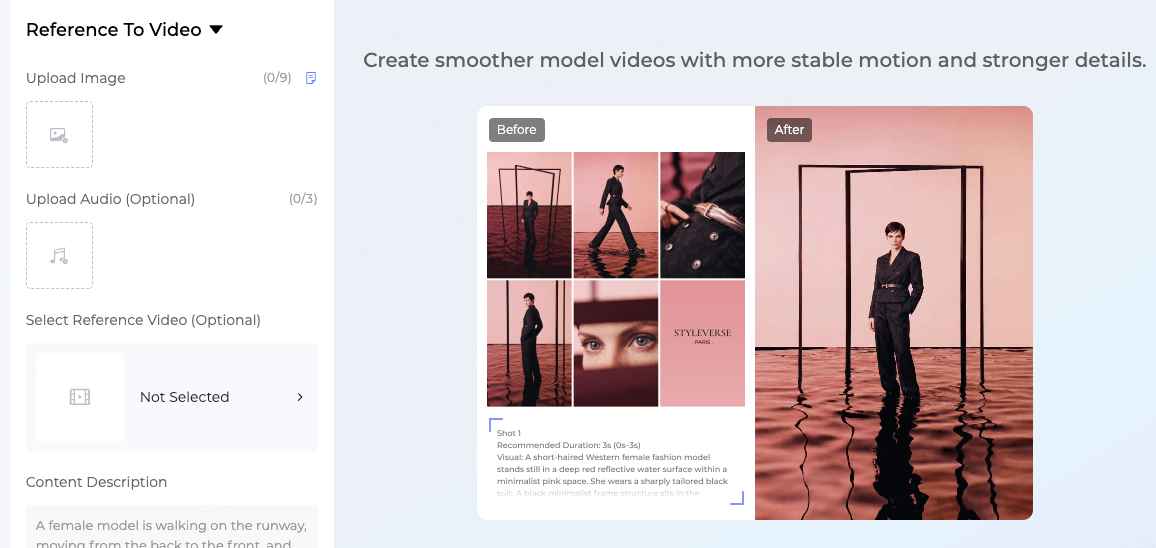


How to Create AI Fashion Videos from Static Images in 2026?
Style3D AI's Style to Video tool transforms static 2D fashion images into dynamic 15-second marketing clips for TikTok and Reels. Start with free generations: upload a garment design from InnoStyle, apply Style Pose for variety, then generate animated runway videos—eliminating photoshoots and saving 80% on costs for brands and designers. Check: Production-ready Visuals What Is an AI Fashion Video Generator and Why Do Brands Need One? An AI fashion video generator converts static 2D garment i