
Outfit Creator Tools: Building Looks That Actually Exist in Stock
A generator optimizes for combinations that look coherent. Coherence and availability are independent properties, and only one of them is visible in the result.
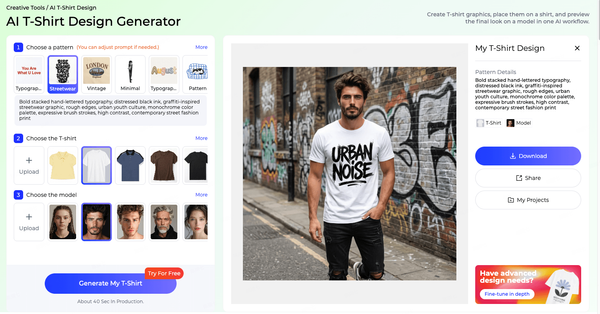
Two different things go by this name. One is a styling toy — a consumer assembles a look from a catalog of images for their own amusement, and nothing has to be purchasable.
The other is a commercial feature: a brand offers outfit suggestions on its own site, and every suggestion is an implicit claim that the combination can be bought. This article is about the second, because the second is where the difficulty is.
The generator optimizes for something other than availability
An outfit generator produces combinations that look coherent. That is what it is built to do, and modern ones do it well — proportions balance, colors relate, the register of the pieces matches.
Coherence and availability are independent properties. Nothing about a combination looking right makes it purchasable, and nothing in the generated image indicates which it is. A visual result showing a complete look is silent on whether the pieces are in stock, whether they are in stock together, and whether they were ever in the same season.
Which produces the failure this article is named for. A generator working from a product catalog will style a discontinued item as readily as a current one, because discontinuation is a fact about the business and not a property of the image.
Availability multiplies down an outfit
Here is the part that surprises people who have not built one of these.
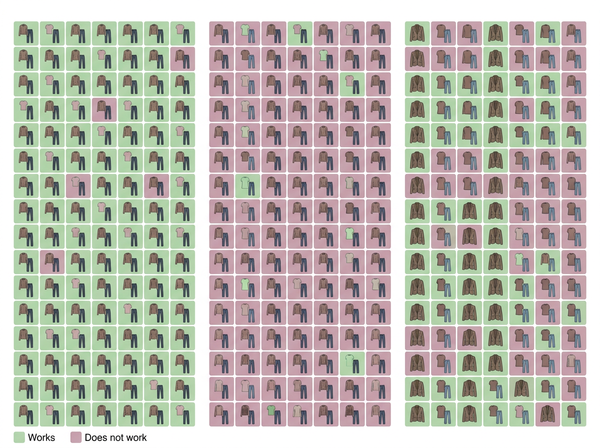
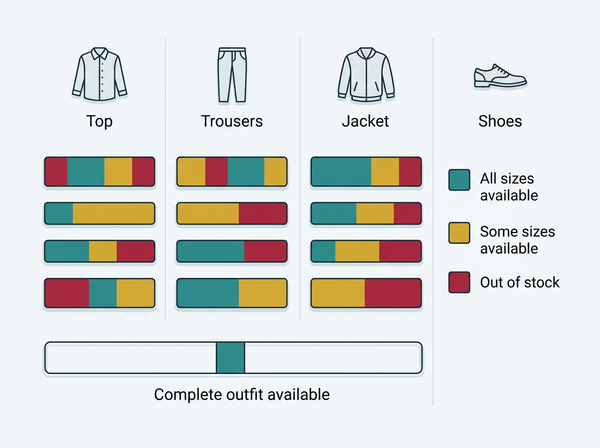
An outfit is a conjunction. It is wearable only if every piece in it is available, which means availability compounds rather than averages. Four pieces, four conditions, all of which have to hold at once.
The size dimension makes this considerably sharper, and it is the part most often overlooked. A piece being in stock is not sufficient — it has to be in stock in a size that works for the same customer as every other piece in the outfit. A combination where the top is available only in small and the trousers only in large is not an outfit for anybody, and every system that checks stock at the item level will report all four pieces as available.
The result is that the true availability of a combination sits well below the availability of any individual piece in it, and the gap widens with every piece added. A generator that suggests five-piece looks is producing suggestions that are much less likely to be purchasable than its three-piece ones, without anything in the interface indicating that.
The compounding also runs against you at exactly the wrong moment. Late in a season, when stock is thin and broken sizes are common, is when a brand most wants to move remaining inventory — and it is when generated combinations are least likely to be purchasable. The feature works best when the catalog is full and degrades when the catalog needs help.
Four joins that have to exist
• Stock level, at the item and variant level rather than the product level, since a product page showing as available may be available in two sizes out of eight.
• Size compatibility across the combination, which requires knowing not just what is in stock but whether the in-stock sizes correspond to one wearer.
• Regional catalog, because a look assembled from a global product list can contain items not sold in the market the customer is browsing from.
• Lifecycle status, covering discontinued, end-of-season, and not-yet-launched — three states that all look identical to a generator reading a catalog.
Missing any one of these produces suggestions that fail at the point of purchase, which is the most expensive place for a suggestion to fail. A customer who liked an outfit and cannot buy it has been given a reason to leave rather than a reason to add to basket.
Outfits go stale faster than products
This is the maintenance property nobody plans for.
When a product sells out, one product page goes out of date. When a product sells out, every outfit containing that product also goes out of date — and a single popular item can appear in many combinations.
So the refresh burden scales with combinations rather than with products, and combinations grow faster than the catalog does. A range that adds a modest number of new pieces adds a much larger number of possible outfits, and each of those is another thing that can become wrong.
Any implementation that generates outfits once and stores them will drift. Generating at request time against live data avoids the drift and costs more per view, which is the real trade-off in building one of these and is rarely framed that way in advance.
Without the joins, it is still useful internally
Worth saying clearly, because the argument so far reads as discouraging.
An outfit generator with no commerce integration is a genuinely useful internal tool. It shows whether a range coheres — whether the pieces actually go together, which is a question buyers and merchandisers argue about with words and can settle faster with images. It finds gaps, by producing combinations that nearly work and revealing what is missing. It supports range reviews by making abstractions concrete.
None of those uses require stock data, because nobody is being invited to buy. This is the same distinction that separates variations from a coherent range: generating combinations is cheap, and deciding which ones mean something is the work.
The joins become mandatory precisely at the boundary where a suggestion is shown to a customer.
The pieces have to look like they belong together
A separate problem, and one that is visible rather than structural.
An outfit assembled from existing product photography combines images shot on different days, possibly by different people, against different backgrounds, with different lighting. Placed side by side in a grid this is tolerable. Composited into a single look it is not — the pieces read as cut out and stacked rather than as worn together.
This is the same set-level consistency problem that governs any group of product images: a set is judged as a set, and an outfit is the most demanding kind of set because the pieces are not merely adjacent but overlapping.
The practical implication is that outfit features work best in catalogs shot to a consistent standard, and retrofitting one onto a catalog assembled over years usually surfaces every inconsistency in it at once.
There is a useful diagnostic in that. Before committing to the feature, take three products photographed at different points in your catalog’s history and composite them into one look. Whatever you see is what customers will see, and it will tell you whether the real project is an outfit generator or a reshoot.
What to check before showing one to a customer
Before an outfit suggestion goes in front of anyone, four things need to be true.
Every piece is available, in the customer’s region, in sizes that work together for one person. The combination reflects current lifecycle status rather than a catalog snapshot. The images combine without obvious mismatch. And there is a defined behavior for what happens when one piece becomes unavailable after the suggestion is generated — whether the outfit disappears, substitutes, or shows as partially available.
That last one is the item most often left undefined, and it is the one a customer will encounter most.
FAQ
Can we launch without stock integration and add it later?
Launching without it means showing customers combinations that may not be purchasable, which trains them not to trust the feature. Recovering that trust later is harder than delaying the launch.
How do we handle a piece that sells out after a suggestion is shown?
Deciding this in advance is the point — the options are removing the outfit, substituting a similar piece, or showing it as partially available with the unavailable item marked. Each has a different effect and any of them beats an outfit that silently leads to a sold-out page.
Does this apply to editorial lookbooks too?
Lookbooks have the same availability problem with a longer tolerance, since they are understood as inspiration rather than as a shopping list. The tolerance is not unlimited, and a lookbook where most pieces cannot be bought stops functioning as marketing.
Should the generator avoid low-stock items?
Weighting away from items about to sell out reduces how often suggestions expire, and it also biases the feature toward whatever is not selling. Which direction to lean is a merchandising decision rather than a technical one.
How many pieces should an outfit contain?
Fewer pieces are more likely to be purchasable, since each addition multiplies the availability condition. Three holds together more reliably than five for reasons that have nothing to do with styling.
Can we use this on a marketplace listing rather than our own site?
Marketplace listings generally do not support cross-product combinations in the way an owned site does, so the feature belongs on a surface you control. What travels to a marketplace is the imagery rather than the interactivity.
Where this leaves you
The generator is not the hard part. Producing a combination that looks right is now straightforward, and the tools do it well enough that the visual result is rarely what limits the feature.
What limits it is everything the image cannot show: whether these four things exist, in this market, in sizes that suit one person, this week. An outfit is a claim about the state of a business, presented as a picture — and pictures are equally happy to depict a state of the business that ended two seasons ago.
Count the joins before building the feature
Before committing to an outfit feature, list what your product data can currently answer: stock at variant level, size availability across a combination, regional catalog, and lifecycle status. Any of the four you cannot query in real time is a source of suggestions that fail at checkout. That list takes an hour to assemble and determines whether the feature is a build or an integration project — which is a much bigger question than which generator to use. See how virtual try-on handles combinations.
→ https://www.style3d.ai/ai-photoshoot/virtual-clothing-try-on
Written by