
Random Outfit Generators: Novelty for Shoppers, Testing for Brands
For a shopper it breaks styling habit. For a brand it samples the combination space of a range, and what it produces says more than what it gets right.
For a shopper, a random outfit generator is a small pleasure. For a brand, the same mechanism is a diagnostic instrument, and it measures something no other method reaches.
Both uses are real. They have almost nothing in common.
What randomness does for a person
People wear a fraction of what they own, and the reason is not that the rest is unwearable. It is that getting dressed involves choosing, and choosing carries habit — the same combinations get assembled because they are the ones that come to mind.
Removing the choice surfaces combinations that exist in the wardrobe and never get made. Some are bad. A few are not, and those few are the entire value, because they were not going to arrive any other way.
That is a genuine use and it is where the search volume comes from. The rest of this article is about the other one, which is what happens when a brand points the same mechanism at its own range.
For a brand, it is a sampler
A merchandiser proposing outfits proposes combinations they already believe in. That is what expertise produces, and it is why merchandised looks tend to work.
It also means the proposals cluster. Combinations that a buyer would not have thought of do not get made, so nobody finds out whether they would have worked. The space of possible combinations in a range is far larger than the space anyone will manually explore.
Random sampling explores it without preference. Point a combination generator at a range, take a sample, and look at what comes out — not to publish it, but to see what the range is capable of producing when nobody is steering.
The value is in the rejects
This is the part that inverts the usual expectation.
When a merchandiser reviews random combinations, the ones that work are mildly interesting. Some will be additions to the range plan; most will be things somebody would have got to eventually.
The ones that do not work are the informative ones, because they say something about the range rather than about the combination. A pair of pieces that clash tells you those two pieces do not belong to the same idea. A dozen combinations that clash for the same reason tells you the range contains two ideas that were never reconciled.
That is a finding about range architecture, and it is invisible when you only look at combinations somebody chose to make — because somebody choosing to make a combination has already filtered for it working.
The failures are also easier to reason about than the successes, which is an underrated practical advantage. Asking why a combination works tends to produce answers about taste, and taste arguments do not converge. Asking why one fails produces answers about specifics — the proportions fight, the two blues are from different families, one piece is dressed for a different occasion. Those are checkable statements, and several of them pointing the same way is a conclusion.
Pure randomness is useless, and that is the interesting part
Sample a range with no constraints at all and most results are nonsense: two tops and no bottom, a coat with a swimsuit, three pieces from different seasons.
So every usable random generator is a constrained one. Something enforces one item per body zone, something excludes incompatible occasions, something keeps seasons apart. Those constraints are not incidental plumbing — they are the merchandising model, written down.
Most organizations have never written it down. Buyers know which pieces go together, in the sense that they can tell you when shown a combination, and that knowledge lives in judgment rather than in rules. Building a constrained sampler forces the rules into the open, and the arguments that happen while defining them are usually more valuable than the sampler.
A common outcome of that exercise is discovering that two people on the same team hold different rules. Both have been merchandising successfully, both are experienced, and their models disagree about something specific — which occasions a piece belongs to, or whether a color sits in one family or another. That disagreement was always there; it only became visible because somebody had to write a constraint down.
Color is where this surfaces fastest. A constraint like “these two colorways do not sit together” requires someone to say why, and the answer is a statement about what a colorway is committing to rather than a preference about shades.
What a random pass reveals about a range
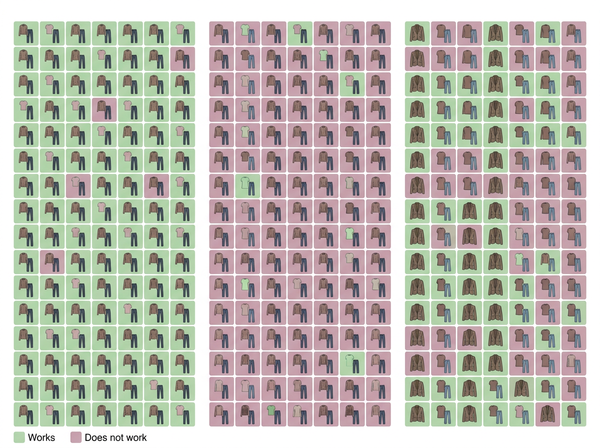
Three patterns, and each means something different.
Almost everything works. The range is internally consistent to the point of being narrow. Every piece sits in the same register, so any combination of them coheres — which is safe and may indicate a range with no tension in it.
Almost nothing works. The range is a collection of products rather than a range. This can be entirely appropriate for some businesses and is worth knowing rather than discovering through customers assembling nothing.
The combinations that work all contain the same few pieces. A small number of items are carrying the range’s coherence, and the rest are riding on them. Those carrying pieces are more strategically important than their sales figures suggest, and losing one to a supply problem does more damage than the sales number implies.
None of these three can be seen by looking at products individually, and none of them appear in a manual merchandising process, which produces working combinations by construction.
The third pattern is the one worth acting on soonest, because it identifies a concentration risk that no sales report will show. A piece that appears in most of the range’s working combinations is holding the range together, and its importance is structural rather than commercial. If it arrives late, gets cut for margin, or sells through early, the combinations that depended on it go with it — and nobody traces the resulting flatness back to one product decision made months earlier.
What it cannot tell you
Sampling explores the combination space. It says nothing about the preference space.
A combination that a merchandiser judges as working is a combination that works aesthetically. Whether customers want it is a different question, answered by data the sampler does not have. Treating sampler output as demand evidence is the main way this exercise gets misused.
It also says nothing about availability. That constraint matters for anything customer-facing and does not matter here, since the exercise is internal and nobody is being invited to buy — which is why a range review can run this before a stock integration exists.
And it does not distinguish combinations that are boring from combinations that are wrong. Both come back as failures of a sort and separating them still requires judgment — a combination nobody would object to is not the same as a combination anybody would choose. The sampler widens the field; it does not evaluate it.
How to run one
• Sample rather than enumerate. A range produces more combinations than anyone can review; a sample large enough to show patterns is the goal, not completeness.
• Review as a batch, not one at a time. The patterns described above are visible across a grid and invisible in a sequence.
• Record why a combination fails, in a word or two. The categories that emerge from that are the finding, more than any individual verdict.
• Run it before the range is locked, since the useful output is a change to the range and there has to be time to make one.
The output that matters is not a list of outfits. It is a short set of statements about the range, which is a different deliverable and easier to act on — much as generating variations is cheap and deciding which ones constitute a range is the actual work.
FAQ
How large should the sample be? Large enough that patterns repeat rather than large enough to be representative. The exercise is looking for structure rather than measuring a rate, so the stopping point is when additional samples stop showing new failure categories.
Should the same person define constraints and review results? Separating them is better, since whoever wrote the constraints will unconsciously review against their own model. A reviewer who did not set the rules notices when the rules were wrong.
Can this replace merchandised looks on the site? No. The output is internal, unfiltered, and includes combinations nobody should publish. What it can do is inform which merchandised looks get built.
Does this work for a small range? It works differently. A small range has few enough combinations to enumerate rather than sample, which makes the exercise faster and the patterns starker. Small ranges most often show the first pattern, everything working, because they were built tightly.
What if the constraints keep needing exceptions? Frequent exceptions indicate the rule is describing something other than what it says. That is a useful signal about how the range is actually organized, and worth pursuing rather than patching.
How often should a range be sampled? Once per range at the point where changes are still possible. Repeating it on a locked range produces observations nobody can act on, which trains people to stop reading the output.
Where this leaves you
The instinct is to judge a random generator by its best output. That is the wrong measure, and it is the measure the consumer version invites.
What a brand gets from it is a picture of its own range that no other process produces — because every other process filters for combinations that work before anyone sees them. Sampling removes the filter, and what comes through says more about the range than about any outfit in it. The rejects are the report.
Sample your range and sort the failures
Take a range that is not yet locked, generate a batch of constrained random combinations, and review them as a grid rather than one by one. For each one that does not work, write down why in two words. What you will end up with is not a list of outfits but a short set of failure categories — and those categories describe how your range is actually put together, which is information no merchandised lookbook will ever give you. See how combinations get assembled and shown.
→ https://www.style3d.ai/ai-photoshoot/virtual-clothing-try-on
Written by