
Outfit Visualizer vs. Configurator: One Shows, One Records
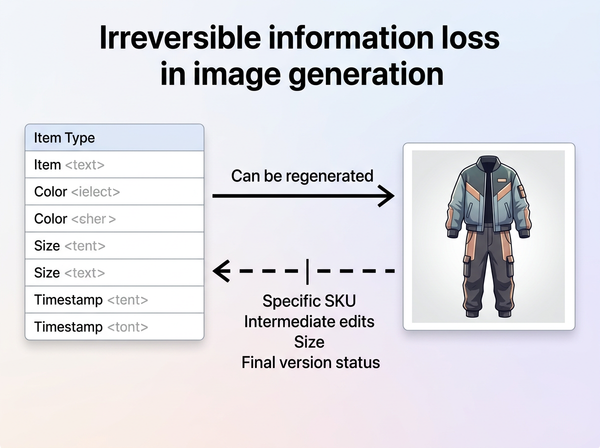
An image can be regenerated from a record of what was chosen. A record cannot be recovered from an image. That asymmetry decides what the feature can ever do.
These two words get used interchangeably, and the products they describe differ in one respect that determines everything the feature will ever be able to do.
A visualizer produces an image. A configurator produces a record of a choice.
The distinction in practice
Both let someone assemble a look. Both show it on screen. From the outside they can be indistinguishable.
The difference is what exists afterward. A visualizer’s output is a picture — pixels, final, unqueryable. Something was assembled, an image was rendered, and what the image contains is now a matter of looking at it.
A configurator’s output is a structure: these items, in these variants, in this order, selected at this time. The picture is generated from that structure and is a view of it rather than the thing itself. Assembling a look on screen is the visible part of both; what is retained underneath is where they diverge.
The asymmetry that decides everything
An image can be regenerated from a record. Knowing which pieces were selected, in which colors and sizes, means the picture can be rendered again at any time, at any size, in any layout.
A record cannot be recovered from an image. Given the picture, you do not know which product variants it contains, whether the person tried three other tops before settling, what size they were looking at, or whether this was their final arrangement or an abandoned one.
That asymmetry runs one direction only, and it is why this is not a detail to sort out later. Building a visualizer and adding a record afterward is not an upgrade path — the sessions that already happened produced images, and the information those sessions contained is gone.
It is worth sitting with how ordinary that loss looks while it is happening. Nothing breaks. The feature works, customers use it, images get shared, and everyone involved reports that it is going well. The absence only becomes visible when somebody asks a question the images cannot answer, which is usually a season or two in, when there is enough usage to be worth analyzing and nothing to analyze.
Aggregation is where the value is
One shared image tells you nothing. Many selection records tell you what combinations your customers actually build.
That is demand information, and there is no other source for it. Sales data tells you what people bought, which is filtered through availability, price, and everything else in the funnel. Merchandised looks tell you what your team proposed. Neither tells you what a customer, given free choice across the range, puts together.
This is the exact gap that combination sampling cannot reach. Sampling explores what a range is capable of producing; it says nothing about preference, because nobody is choosing. A configurator records choosing — the same combinations, arrived at by someone with an intention.
The patterns that emerge are the useful part: pieces that appear in configurations far more often than their sales suggest, combinations nobody on the team would have proposed, and options that get selected and then abandoned, which is a signal you cannot get from a checkout at all.
The abandonment signal deserves particular attention because of where it sits in the funnel. A customer who selects an option and then replaces it has expressed a preference and then withdrawn it, in a moment nothing else observes. Aggregate that across a season and you learn which options attract and fail to convince — a distinction that sales figures collapse into a single low number and attribute to lack of interest.
What each one lets you do next
Afterward | Visualizer | Configurator |
Show it | Yes | Yes |
Share it | As an image | As a link that reopens editable |
Price it | No | Yes |
Check availability | No | Yes |
Add to cart | Not reliably | Yes |
Save and return | As an image | As a state |
Aggregate across users | No | Yes |
Everything in the right column requires knowing what the items are. Everything in the left column requires only that a picture exists.
The cost is the catalog, not the interface
The expensive part is not the front end. It is that a configurator requires the catalog to be modeled.
Every option has to be expressed as data. Every constraint — this fabric is not available in this style, this size runs only in these colors — has to be stated rather than known. Every dependency between choices has to be encoded. That work is the same modeling problem that separates a set of variations from a structured range, and it usually lives in several systems and several people’s heads rather than in one place.
A visualizer needs images and a way to layer them. That is genuinely simpler, and for some purposes it is the correct choice.
Projects go wrong when they are scoped as the first and delivered as the second — the interface looks similar in a specification, and the modeling work does not appear until somebody asks what happens when a customer picks a combination that cannot exist.
Which makes it worth naming the cases where a visualizer is the right answer rather than the cheap one. They share a property: nobody is going to act on the output as a transaction.
Editorial and campaign work, where the point is to communicate a look rather than to sell a specific set of items. Inspiration features, where the customer is browsing rather than assembling. Internal range review, where the audience already knows the catalog and does not need the system to model it. Anything where the output goes into a presentation.
In all of these, the record would be overhead with no use, and building one would be paying the modeling cost for nothing.
The hybrid that fails
The common mistake sits between the two: a visualizer with a buy-this-look button.
It looks like a configurator to the customer, so they behave as though it is one — they assemble something specific and expect to purchase it. Underneath, there is no record of what they assembled, so the button has to infer, and inference at that point is guesswork about which variants were on screen.
What follows is predictable: the cart contains the wrong size, the wrong colorway, or fewer items than the customer built. And because the failure happens at the last step, it lands on the part of the page where trust is most expensive to lose.
If a button is going to appear, the record has to exist. If the record is not going to exist, the button should not appear — showing the look and letting the customer navigate to items individually is slower and honest.
The version of this that fails most quietly is a button that works for simple products and guesses for complex ones. It passes testing, because testing uses a product with one variant, and it starts producing wrong baskets the first time somebody configures something with a size and a colorway. By then the feature has shipped and the failures look like customer error.
What the record should contain
• The selected items and their specific variants, since a product identifier without a variant is not enough to add anything to a basket.
• The intermediate states, meaning what was selected and then replaced, which is the signal least available anywhere else.
• When, so that sessions can be related to campaigns, seasons, and stock states.
• Where the session started, since a customer arriving from a product page behaves differently from one arriving from a campaign.
• Whether it was acted on, which turns the whole dataset from interesting into measurable.
The middle two are the ones most often omitted and the ones that make the data worth collecting rather than merely worth having.
FAQ
Can a visualizer be upgraded to a configurator later?
The interface can be rebuilt, and the historical sessions cannot be recovered — they produced images. Whether that matters depends on whether the aggregate data was part of the reason for building it.
Do we need a configurator to show outfits at all?
No. Showing outfits requires images. A configurator is required when something downstream has to act on the selection — pricing, availability, purchase, or analysis.
Is the modeling work reusable?
Substantially, because a modeled catalog serves configuration, availability checks, and several other features. It is expensive as a one-off and reasonable as infrastructure, which is the framing that usually gets it funded.
What about a configurator with no images?
A structured selection tool without visualization exists and works for categories where the customer understands the options without seeing them. For apparel it rarely does, since the combination is the thing being evaluated.
How do we handle a combination the catalog cannot produce?
That is precisely what the constraints are for, and the answer should be preventing the selection rather than failing afterward. Constraints that are not modeled become errors at checkout.
Does this apply to made-to-order products?
More strongly, since made-to-order has no stock to check against and the record is the order. There the configuration is not a preference signal but the specification itself.
Where this leaves you
Ask what has to happen after somebody assembles a look.
If the answer is that they look at it, share it, and possibly feel something, a visualizer does that and the modeling cost buys nothing. If the answer involves price, availability, a basket, or a report, then a record has to exist from the first session — because the sessions that happen before the record exists produce images, and images are where information goes to stop.
Write down what happens after the look is assembled
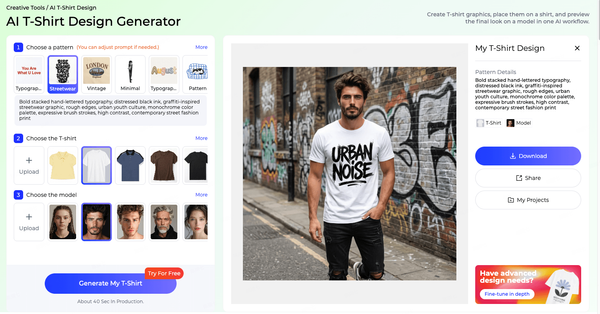
Before scoping an outfit feature, list every action that has to be possible once a customer has built something: view, share, price, check stock, purchase, save, analyze. Anything past the first two requires knowing what the items are, which means a record, which means modeling the catalog. That list separates a front-end project from an integration project — and it is much cheaper to discover the difference before the interface is built than during the sprint where somebody asks how the cart knows what to add. See how outfit assembly works on screen.
→ https://www.style3d.ai/ai-photoshoot/virtual-clothing-try-on
Written by