
Virtual Eyewear Try-On: Three Fits and One Reflection
Three separate fits decide whether a frame works, and only one of them is about how it looks. What a try-on image settles and what stays with the optician.
Eyewear is the hardest accessory to show virtually, and the reason is not that faces are difficult. It is that a frame has to fit in three separate ways, and its most visible surface is doing three optical jobs at the same time.
Three fits, and only one is about looks
The bridge. Where the frame rests on the nose determines how high it sits, how far it stands off the face, and whether the lower rim touches the cheek. Two frames with identical dimensions sit differently on different noses, and the difference is visible.
The temples and the ear. Arm length and where the bend falls decide whether the frame sits level and whether it slides forward through the day. This is largely invisible in a front view and entirely determines whether the glasses are comfortable.
The optical alignment. The centers of the lenses have to correspond to where the wearer’s eyes are, which is a measurement taken by an optician rather than a property of an image.
The first is aesthetic and partly visible. The second is geometric and mostly hidden. The third is neither — it is a number, and no photograph settles it.
Those three are also handled by three different parties. Style is the customer’s call, the geometric fit is adjusted by whoever hands over the frames, and the optical alignment is measured. A try-on operating on the first of the three is doing a real job; the trouble starts when a purchase flow implies it has covered all three.
The lens is doing three things at once
Most product surfaces do one thing optically. A lens does three.
It transmits, so the eye behind it is visible through it. It reflects, so the environment appears on it. And it may be tinted, so what passes through arrives changed.
Those behaviors interact. A tint alters what shows through and what the reflection looks like. A reflection can obscure the eye entirely at certain angles. Getting one right while getting another wrong produces a result that reads as strange without anyone identifying why.
This is a step beyond the difficulty of sheer fabric, where a single behavior — light passing through — has to be handled correctly. It is also different from a watch face or any other reflective product, because those reflect without transmitting. A lens does both, and the two have to agree with each other.
For comparison, a hat interacts with the head in one way and sits on top of it. A frame passes through the visual field, which is a different category of problem.
The reflection is always the wrong room
A lens has to reflect something. Whatever a virtual try-on decides to put there is not the room the customer is standing in.
Generic reflections are the usual approach — a soft highlight, a suggestion of a window. They read as plausible and they belong to nowhere, which is the same trade that applies whenever an environment is supplied rather than captured.
Using the customer’s own camera feed as the reflection source is possible and produces its own problem: the reflection then shows the room the camera sees, which is behind the customer rather than in front of them. Physically, a lens reflects what is in front of the wearer, and the camera is standing in that position — so it is closer to correct than a generic reflection and still not the geometry a person sees in a mirror.
There is no version of this that is right. Which reflection is least wrong depends on how much the frame is defined by its lens, and mirrored or heavily tinted styles are where it matters most.
A reasonable design response is to reduce rather than to perfect. A understated, low-contrast reflection reads as a lens without asserting anything about the environment, and it ages better than a detailed one that is confidently showing a room nobody is in. Ambition on this particular surface tends to make the result less convincing rather than more.
The eye behind the lens
Here is the part that goes unmentioned and affects the largest group of customers.
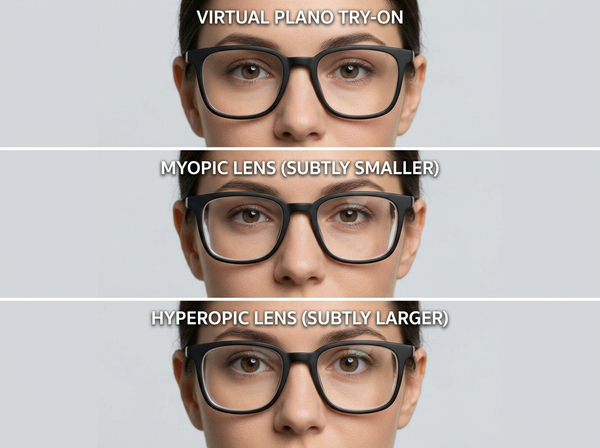
A virtual try-on shows plano lenses — flat, no correction. Anyone buying frames for prescription lenses will receive something that behaves differently: corrective lenses magnify or reduce what is seen through them, so the eye appears slightly larger or smaller, and the edge of the frame produces a visible step where the face behind it shifts.
The effect is subtle at moderate corrections and unmistakable at strong ones. It is also the single most reliable difference between how frames look in a try-on and how they look on the person once the glasses arrive.
Which produces an uncomfortable asymmetry: the try-on is most accurate for people buying frames without correction, and least accurate for the people who need glasses in order to see. Nothing in the interface indicates this.
Sunglasses are the easy case
The reason sunglasses try-on is common and prescription try-on is rare is not marketing. It is that dark lenses remove two of the three problems.
A tinted lens hides the eye, so the transmission behavior does not have to be correct and the prescription effect does not arise. What remains is the reflection, which is the most forgiving of the three because viewers have no strong expectation about what a sunglass lens should be reflecting.
That leaves the geometric fit — bridge, temples, and how the frame sits — which is a solvable problem and the same one every other accessory has.
So sunglasses are a category where virtual try-on genuinely works well, and prescription eyewear is a category where it settles style and hands everything else to an optician. Treating those as the same feature is how expectations get set wrong.
Contact points a front view hides
Three places where a frame meets a face, none of them visible in a straight-on view.
The nose pads, which determine height and standoff and are where most fit adjustments are made. The temple tips behind the ear, where length and curve decide whether the frame stays put. And the cheeks — a frame that is too wide or sits too low touches the cheek when the wearer smiles, which is a fit failure that only appears in motion and never in a photograph.
The smiling case is worth naming specifically because it is common, it is not a defect in the frame, and it is discovered after purchase. A try-on that shows a neutral expression from the front cannot surface it, and asking a customer to smile does not help either, since the frame in the image is not physically resting on anything.
What a try-on can and cannot settle
• Style, proportion, and color against the face — settled well, and this is genuinely most of the purchase decision for many customers.
• Whether a frame is too wide or too narrow — approximately, since apparent width relative to the face is visible.
• How it sits at the bridge — partially, depending on how the try-on handles depth.
• Whether it stays level and stays put — not settled, since this depends on the temples and the ears.
• Optical alignment — not settled, and not settleable from any image.
• Comfort — not settled, for the same reasons that apply to every product.
The pattern is the same one that governs try-on across categories: an image settles appearance rather than fit. Eyewear differs in that the fit half includes a measurement rather than only a physical sensation.
FAQ
Why do frames look different in the try-on than when they arrive?
The most common cause for prescription wearers is that the try-on showed uncorrected lenses. Beyond that, how the frame actually rests on a particular nose and ears differs from where a virtual overlay places it.
Does a face scan improve accuracy?
It improves the geometric part considerably, since depth information helps place the frame relative to the nose and cheeks. It does not address the lens behaviors or the optical alignment.
Can virtual try-on replace an in-store fitting?
For style selection it does most of the work. Optical measurements are taken by an optician, and the physical fit of the temples is assessed with the frame on the head.
Why do some try-ons look convincing and others do not?
Usually the reflection and the way the frame’s edge meets the face. Those two carry most of the perceived realism, and both are approximations.
Are mirrored or gradient lenses harder?
Yes, since more of the frame’s appearance comes from the lens surface and the reflection therefore carries more weight. Clear-lens frames rely less on getting the reflection right.
Should product pages show try-on results or photographs?
Both do different jobs — photographs establish what the product is, and try-on establishes how it relates to the viewer’s own face. Neither substitutes for the other.
Where this leaves you
Eyewear is where the gap between appearance and fit is widest, because part of the fit is a number.
A try-on can show a customer whether a frame suits them, which is a real service and the reason the feature exists. It cannot show whether the lenses will sit where the eyes are, whether the frame will stay level, or what the world will look like through it. Those are settled elsewhere, by someone with a measuring device — and a try-on that presents itself as the whole decision has quietly taken on a job it was never doing.
Check what the lenses are doing
Look at your own try-on output and ask three questions about the lens rather than the frame: what is it reflecting, can you see the eye through it, and is the eye the size it would be through the customer’s actual prescription. The third has no good answer, which is worth knowing before a customer discovers it on delivery. Frames without correction are the case where try-on is most accurate, and that is the smaller half of the market. See how virtual try-on works and where it stops.
→ https://www.style3d.ai/ai-photoshoot/virtual-clothing-try-on
Written by